Medicine Interviews: Guidance for Interviewers

For 2026 entry, we will run the Medicine interviews for home applicants in-person. In-person interviews will take place during the weeks commencing Monday 19th January 2026, Monday 26th January 2026 and Monday 2nd February 2026 at Birmingham Medical School. Online interviews for international applicants will take place on Thursday 12th February 2026 and Friday 13th February 2026.

It is important that you read the frequently asked questions below to find out more about how interviews will work and what you need to do to prepare. Thank you once again for helping us in the selection process for our new Medicine cohort. 

Welcome!

Professor Kate Thomas, former Dean of Birmingham Medical School and Programme Director for the MBChB, introduces the role of the interviewer.

Online Interviews for Medicine 2025 - Interviewer Introduction

Safeguarding

As an organisation interacting with children and young people, we must view child protection and safeguarding as all of our responsibilities; remember, many applicants will be under 18 years of age at the time of their interview and the majority will still be at school.

You must sign a code of conduct here before taking part in our interviews. By agreeing to be an interviewer you are also agreeing to abide by and follow the code of conduct. You must:

  • Comply with the University’s guidelines and applicable UK Laws regarding interacting with children.
  • Be fair and treat everyone with respect and dignity in accordance with our Equality and Diversity policy – maintaining sensitivity to children’s appearance, race, culture, religious belief, sexuality, gender or disability.
  • Respect a child’s right to privacy.
  • Communicate in an open and respectful way during the interview.
  • Ensure any content shared with the candidate is only that which is provided by the University of Birmingham alone.
  • Not make inappropriate contact with children using social media or exchanging any contact details.
  • If you have concerns for a candidate’s wellbeing during the course of an interview, please raise with the admissions team on the day.
  • If you have concerns about a child, please request an incident form from us and note these down, they will then be passed on to the College of Medicine and Health Child Protection Officer for consideration of next steps.
  • If you believe someone is at immediate risk of harm, please again inform the admissions team who will immediately contact the relevant services.
  • Key forms of abuse to look out for in children are, emotional abuse, physical abuse, neglect and sexual abuse – further information about types of abuse will be included in your briefing email along with the University’s child protection and safeguarding policy and our MMI policy.
  • The principles of safeguarding are not only to safeguard children from harm but also to ensure that staff or students are not put in a position where their conduct or integrity can be questioned. If you are concerned by anything you see or hear in an interview, please inform us immediately.

The process

  • We will continue to operate a Multiple Mini Interview (MMI) format; where candidates move through a cycle of separate stations and are assessed independently at each.
  • The MMIs will be held in-person for home applicants. There will be 6 cycles of 7 stations each day, with two cycles running concurrently, which enables us to see up to 1,260 applicants at interview (excluding international) over 3 weeks from mid-January. These stations will consist of:

-          Commitment and insight into medicine

-          Critical thinking

-          Professionalism

-          Dealing with personal and ethical challenges

-          Data interpretation

-          Calculation (computer-based station)

-          Role-play (interaction in a healthcare setting)

  • Each candidate will have 2 minutes of reading time (or 2.5 minutes for extra reading and preparation time circuits) and 6 minutes for the interview or to complete each station; a total of 8 or 8.5 minutes per station. Each circuit will therefore take at least 56 minutes, after which there will be a brief interval to allow interviewers to complete their marking and have a short break. 
  • International applicants will be interviewed online in two sessions that will take place after the in-person interviews in early February. These will be held using Zoom, and will include a role play and at least one other station. Details of the process and timings will be sent to those that sign up to these sessions. 

How to facilitate an interview 

As an interviewer, your role is to facilitate the interview process and mark the candidate based on their answers. You will be provided with:

  • The scenario with set questions.
  • Anchor statements to guide marking.
  • A guide to the issues and concepts that the applicant should address.
  • A tablet on which to record your marks and any additional observations.

To be an effective facilitator, please try to put candidates at ease by greeting them, smiling and briefly introducing yourself.

Two key skills in facilitating the MMIs are:

Active listening

Listening and giving full attention to the candidate by:

  • Maintaining eye contact.
  • Nodding your head.
  • Smiling.
  • Giving general agreement and encouraging the candidate, but not commenting specifically on the quality of what is said.

Effective questioning

You should ask the questions set out in the scenario documentation. However, where appropriate, you should also:

Ask follow-up probing questions:

These help you to dig deeper and go beyond surface answers and can help clarify points raised by the candidate. Effective probing can also allow you to ascertain the degree to which the candidate is demonstrating genuine 'reflection’ and ‘critical thinking’.

Facilitate the discussion - nudge the candidate and encourage them to go further:

If you can see that the candidate is struggling to grasp the concepts explored in the station, you may need to reword the question. If you have to guide the candidate more than once, you should award a lower score. If you have to suggest a specific topic or idea, or ask them to provide additional answers, then this is PROMPTING. If the candidate needs this, the score they receive must be low.

Ask closed questions:

A close-ended question may be useful for obtaining specific information and usually requires only a yes or no answer. It does not encourage discussion so only use sparingly; however these questions are useful for confirming facts.

Marking candidates – how will it work?

  • All marking and related information on candidates will be captured  electronically.
  • For in-person MMIs, you will be given tablets on the day to record your marks and any other observations. These will already be logged in for you and ready to use.
  • Further guidance and instructions will be provided in our training webinar as well as on the day of the interview. 
  • Candidates are marked from Excellent to Poor in a variety of domains specific to the station. Guidance on what category best applies to a candidate's performance is provided via 'anchor statements' for each domain.
  • For online MMIs, you will be given a link and password for the web-based version of the assessment platform where you will record your marks.

Attributes we are looking for

We look for candidates that show great potential to become doctors who are able to take care of the sick and vulnerable patients that will rely on them, showing attributes that are in line with NHS values. These include: 

  • Teamwork (if a candidate has no experience of this and all their interests and schoolwork are done in isolation, it could be a red flag).
  • Passion, with a genuine interest in other people.
  • Wanting to be a doctor for sensible and realistic reasons.
  • Willingness to work hard.
  • Good communication skills.
  • Broad outlook on life - we interview a wide range of candidates from different backgrounds and we are more interested in what a candidate has learned from the examples they are giving than the details of the experience itself. We want to know how they have reflected upon their experiences and what they have understood about the people they have met.
  • A desire to get as much out of their time at the University of Birmingham as possible.
  • Appropriate attitudes and beliefs.
  • An ability to build relationships quickly, although they may initially come across as shy and nervous in an interview situation.
  • Honesty (although this can be difficult to detect). If an answer seems rehearsed, you can ask for another example to be provided that seems more grounded.
  • Robust – good coping strategies and appropriate responses to stress.
  • Compassion - arguably the overriding attribute.

We want to probe candidates and see what’s beneath the surface of their initial answer. If anything about the interview concerns you, please make a note of it.

Unconscious bias

We require all interviewers to be up to date with their employing organisation's equality, diversity and inclusion (EDI) training. However, interviews can be particularly impacted by 'unconscious bias', a term which refers to biases that we are unaware of and which may influence our thinking and decision-making that happens outside of our conscious control.

Unconscious bias happens automatically and is triggered by our brain making quick judgments and assessments of people and situations. Our biases are influenced by our background, cultural environment and personal experiences. How many times do you “just have this feeling” about a candidate? Were those feelings based on observable evidence and objective criteria or were they influenced by unconscious biases that reflect your previous experiences or personal preferences?

It is possible to reduce the impact of our unconscious biases on our decisions. These include:

  • Recognising that we all have unconscious biases. Acknowledging these and being aware of them is the first step to reducing the influence of unconscious bias.
  • Be mindful and consider all aspects of the candidate’s interview performance.
  • Use the standardised marking scheme to guide you in awarding marks. An example of unconscious bias to avoid is the ‘halo effect’, where one positive trait can affect our overall perception of a person. For example, preferring a candidate who went to a certain type of school because you associate it with intelligence. However, you know on reflection that the school a candidate went to does not automatically mean they are more intelligent than other candidates.
  • After you have completed the interviews, take time to think about exactly what it was that a candidate did or said that made you feel that a high or a low mark was appropriate. 
  • Give yourself time to pause, self-check, and focus on what is actually positive or negative about a candidate’s responses, and how these map to the anchor statements provided. You will then be giving yourself the chance to make the best decisions possible.

If you want to learn more about your unconscious bias, you can consider taking the Harvard Implicit Association test and reviewing your results.

Getting here and parking information

Please see our 'Getting here' webpage for travel advice on how to get the University.

Please find an interactive version of the campus map, which also contains a PDF version you can download.

Car parking is limited on campus so we actively encourage visitors to use public transport where possible. There is a parking permit available for those who wish to attend by car. The address for Birmingham Medical School is:

The Medical School
The University of Birmingham
Vincent Drive
Edgbaston
Birmingham
B15 2SA

Car parking permits

We are making arrangements to be able to email a printable parking permit for those who request it. Permits must be printed off ahead of time and displayed in the windscreen of your car on the day of use. This will exempt you from paying to park but unfortunately doesn’t guarantee you a space, so please do arrive in good time.

The downloadable parking permit will be emailed to you a couple of days before your interview shift. Please note that if you do not display your permit, you may incur a parking fine. If you do not request the car parking permit beforehand, we unfortunately cannot reimburse parking.

Campus security barriers

If arriving by car you will notice several security barriers whilst driving in and around campus. Please press the button on approach and wait a few moments. When Security responds please explain that you are an interviewer for the Medical School and they will lift the barrier for you and enable you to continue driving through. They may remind you to display your permit.

Where to park

In the first instance the new multi-story car park just off Vincent Drive (number 1 indicated on the map below) would be first choice and then others after that marking in numerical order should there be no space.

The map below aims to provide some time-saving advice on the best places to check for possible empty spaces, as the car parks can fill up very quickly before 9am. The areas circled in red show the best locations to try (car parks adjacent to University Road West, outside G4 and the North East Car Park Multi-Storey). The green arrows show the advised driving route to check all on the way, however, there are many other parking spaces around campus. Please be mindful that there could be up to a 10min walk from any of the surrounding car parks so please do anticipate this when planning your arrival time. 
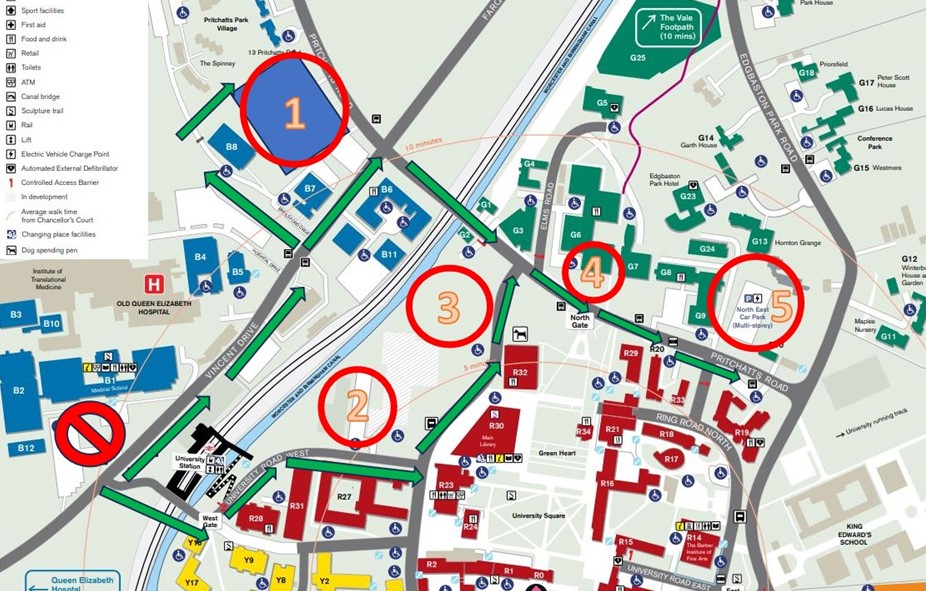
Parking with number 1 car park located at Pritchetts Road, number two car park located at University Road West opposite the Murray Learning Centre, Car park number 3 is opposite is opposite Pritchatts road, car park 4 is next to Metallurgy and Materials a

FAQs

Where do I report to on the day?

  • You will need to report to the west wing of the Medical School (enter via the main entrance and follow signage). The rooms in use will be on the first floor, WF15 and WF19. One room will be for candidate registration and the other will be where the interviews are held.
  • If you need assistance due to impaired mobility or other additional needs, please let us know ahead of your interview slot.

I need to reschedule or cancel my interview session, what do I need to do?

  • If you need to cancel or rearrange your interview session up to a week before your interview session, please use your personal RSVP page to amend or cancel your attendance (a link to your unique RSVP page will be sent in your booking confirmation email).
  • If you need to cancel less than a week before your interview session, please email us at med-admissions@contacts.bham.ac.uk so that we have as much time as possible to find a replacement. We cannot run an interview cycle without sufficient interviewers and we have only limited numbers of reserve interviewers.

What if I am running late for my interview?

  • We would ask that you arrive in plenty of time prior to your interview slot. This will give you the opportunity to familiarise yourself with the station, marking criteria and interview process.
  • If you are running late for an interview session, it is important to let us know as soon as possible via the number or email address below so that we can try to find an urgent replacement.
  • If you cannot not make your interview session, please remember to cancel your slot using your RSVP page.

What if something disrupts one of the interviews on the day?

  • If something disrupts the interview on the day or you feel a candidate is unable to complete their interview, please inform a member of the admissions team as soon as possible.
  • If you have concerns for a candidate’s wellbeing during the course of an interview, please inform a member of the admissions team as soon as possible. You may also contact us via our Medicine email address for less urgent issues. 

What if the tablets do not work on the day?

  • If your tablet or the Wi-Fi network is not working properly, we will switch to using a pre-prepared spreadsheet template document (one per candidate); we will have paper copies available to hand out in emergencies. Please note that this option is only available in cases of technical failure, it should not be seen as an alternative to using the electronic marking system.

What if a candidate requests extra reading time?

  • We will have designated interview sessions for candidates that require extra reading and preparation time.

Who do I need to contact if I have a query?

  • You can email us via med-admissions@contacts.bham.ac.uk. During the interview days, our email answering times will be delayed so please call 07970 983 505 in case of an emergency.
  • We will send you a reminder with full details of your interview slots and interview arrangements a few days before your interview session.