A roundup of some of the work done by students and staff using the University’s special collections so far in 2026.
From a returning casualty to a celebrity chat: the YMCA's serial publications and social change
For her Collaborative Research Internship with the College of Arts and Law, Carina Walker explored the serial publications of the Young Men Christian Association’s (YMCA) National Council.
I worked with the Association’s longest running news magazine, which started life as The Red Triangle after the First World War and was subsequently called The British YMCA Review, The YMCA Review and lastly YMCA World (reference YMCA/6/1/9) until publication stopped in 1979. Renamed, reworked, and reformatted across the decades, the magazine reveals how the YMCA adapted to shifting global situations and the changing interests of its young members.
In 1918 the publication consisted of long-form essays, many of which contend with mass demobilisation and its effect on ideas of masculinity, citizenship and social progress. The Association’s connection to the military remained a key thread throughout the first half of the twentieth century. Having ceased production during the Second World War, in 1948 the magazine called itself a returning casualty, revived in a smaller and less frequent form due to paper shortages. The magazine's articles reveal its tenuous global position, which is evident in the fraught interactions between military control, religious cooperation and charitable presence in the Association's work in Egypt.
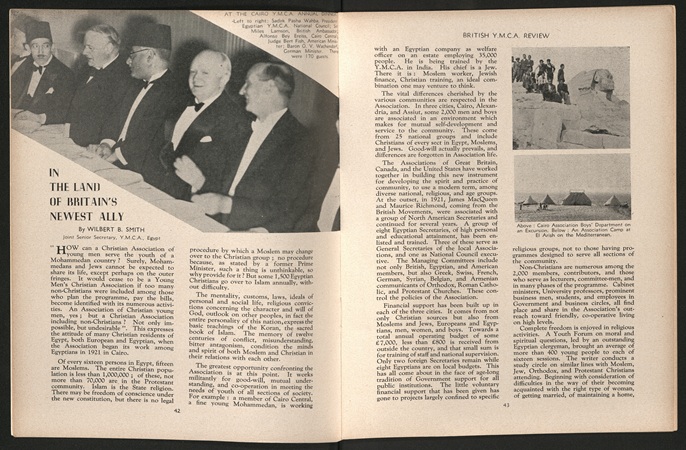
The article ‘In The Land of Britain’s Newest Ally’ (Egypt) in The British YMCA Review, November 1938. Reference: YMCA/6/1/9/3.
In the 1960s the magazine reorientated itself, responding to post-colonial developments, renewed anxieties about teenagers and Christianity’s place in the world. The tone of the articles became more informal and sought to appeal to young people on their own terms. Acknowledging the ineffectiveness of direct preaching, the Association attempted to embrace youth culture through pieces such as one about coffee bars and interviews with celebrities such as Bobby Charlton, who is proudly touted as a former Young Men’s Christian Association member.
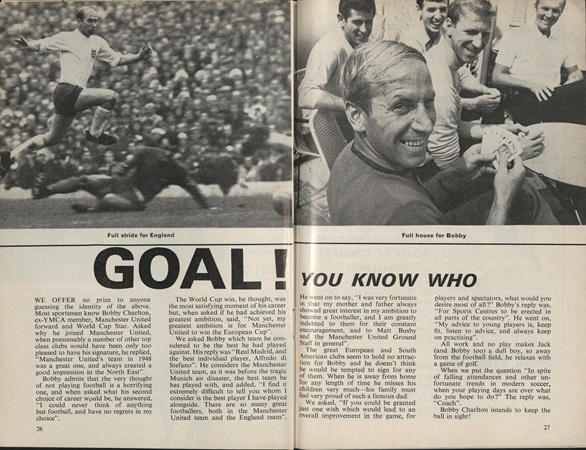
Bobby Charlton plays cards with YMCA members. From ‘Goal! You Know Who’ in YMCA World, Spring 1968. Reference: YMCA/6/1/9/8.
Mark Lewis: finding time for the archives
As a part-time History PhD researcher, fitting study around childcare and work, any day I can spend on campus or in an archive feels especially valuable.
When my supervisors suggested I explore the university’s Special Collections, I was excited: I didn’t know it existed! Before visiting, I used Cadbury Research Library’s CALMview online catalogue to identify materials from my period of interest – the long seventeenth century. I was delighted to find handwritten commonplace books, diaries, and an account book, each offering insights into my research topic: the nature and role of giving in everyday life among ordinary, middling communities.
The staff were brilliant throughout my visit. They registered me quickly, had everything I’d pre-ordered ready, and were endlessly helpful as I requested additional items over the two days I spent there.
As my first proper archive visit, it was a chance to learn how to handle the manuscripts and get a feel for how these documents were created and used. Seeing them in person offers something no digital copy can. A few of the items turned out to be directly relevant to my research, which was great, yet the biggest value was broader: handling these sources helped me refine what I should be looking for elsewhere.
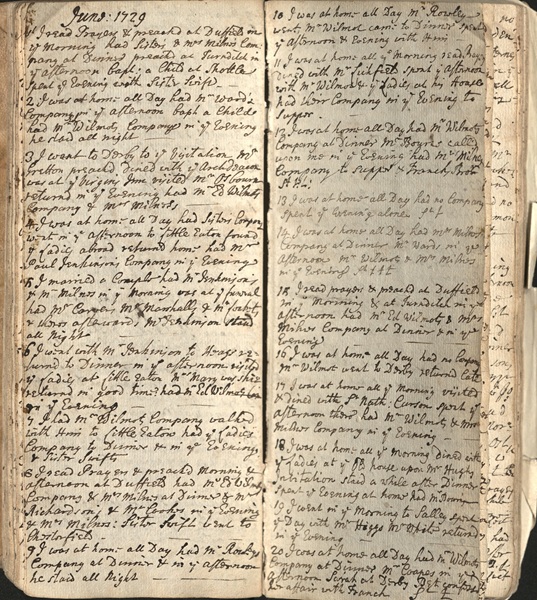
An item at Cadbury Research Library, the diary (1727-1731) of Thomas Calton (c. 1685-1735), the Vicar of Duffield, in which Calton records how he discharged his parish and pastoral duties, and met and socialised with members of the community. Reference: MS574.
With that clarity, I searched the National Archives catalogue and the catalogues of nearby archives, locating relevant materials at both the Warwickshire County Record Office and Derbyshire Record Office, such as a man requesting a loan from a neighbour among parish papers, and the household accounts of Lady Newdigate.
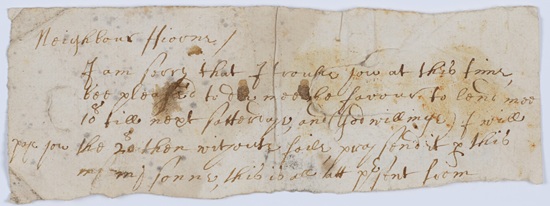
From Warwickshire County Record Office, a request to ‘Neighbour Hiorne’ for a loan of ten shillings ‘till next satterdaye’, showing a glimpse of the seventeenth century’s day-to-day negotiation of credit, charity and neighbourliness. With kind permission from Warwickshire County Record Office. Warwickshire’s reference: DR0458/59.
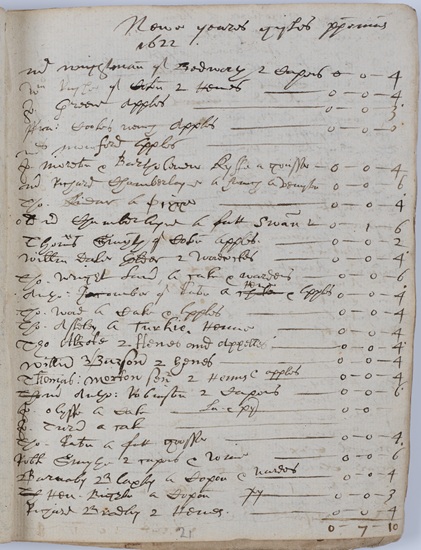
From Warwickshire County Record Office, a list of New Year’s gift presents the Newdigate family received in 1622. From the Newdigates’ volume of household lists and accounts. The family lived in Arbury Hall, Warwickshire. With kind permission from Warwickshire County Record Office. Warwickshire’s reference: CR136/A37.
Having a resource like Special Collections on campus is incredibly valuable: accessible, welcoming, and full of fascinating material.
The Cadburys at Cadbury Research Library
Whilst researching the University of Birmingham’s involvement in the First World War, Peter Vessey compiled a database of all traceable staff and students using the University Archives, specifically the year books published by Mason College calendars, the University’s calendars, and the University student record cards.
As I organised the details, it struck me that the Cadbury family had taken advantage of the tertiary education facilities being developed in Birmingham. My list contains twenty-three members of the extended family: eighteen girls and women, and five men. One man was listed twice, for the same year, once as Norman George AND as George Norman!
The members range from Elsie Dorothea, born 1892, who apparently studied modern languages aged three, to Margaret Christobel who graduated B.A. in 1932 aged 50.
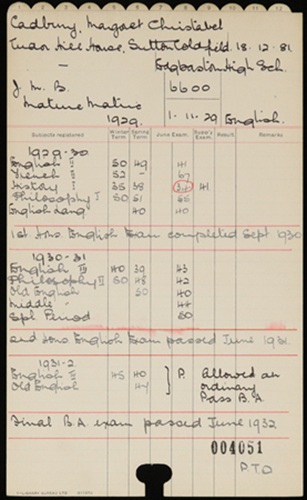
The student record card for Margaret Christobel Cadbury. Reference: UB/STU/A/3/1.
An interesting member of the family was Elizabeth Mary Taylor (1858–1951) who became George Cadbury’s second wife in 1888. She was very involved in social work and studied it at Mason Science College from 1888–90. She took on five stepchildren and had six of her own. In 1909 she founded the Woodland Hospital for Disabled Children, and, during the First World War, qualified as a Staff Nurse with the Q.A.R.N.S., rising to Sister. She ended up with a D.B.E. and the Belgian Order of the Crown.
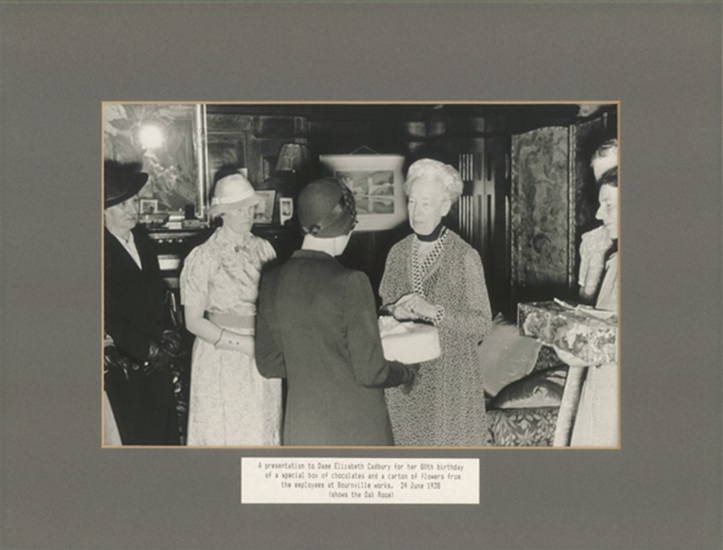
A photograph of Elizabeth Mary Cadbury (nee Taylor), DBE, student, stepmother, nurse, hospital founder, activist, politician and philanthropist, receiving chocolate and flowers from Cadbury employees on her 80th birthday. Reference: UB/HMH/A/1/7.
A few of the family were involved in establishing the University while not studying here. The minutes of the Building Committee record that, when the landscaping and planting was being carried out in 1908, William Adlington Barrow Cadbury lent the University his team of gardeners who helped spread the contents of 1,000 cartloads of “road scrapings”. Also minuted is the gardeners laying out the staff bowling green and William’s donation of the related pavilion.
Although the majority of the Cadbury’s archival material is based at Bournville, with CRL’s Cadbury Papers being mostly about the Cocoa trade in West Africa between 1900 and 1960, there is always the possibility of encountering a Cadbury at Cadbury Research Library!
Tuning the British Organ Archive
In April we welcomed the new British Organ Archive (BOA) Archivist, Elliot Fountain, to Cadbury Research Library.
BOA is a large, diverse and wonderful collection of records and publications relating to organs and organ builders, accumulated under the auspices of the British Institute of Organ Studies (BIOS).
The archive is over 700 boxes of archival material strong. Its key section is the business records relating to organ builders, though the records also include technical drawings, large plans, glass slides, printed books and periodicals. Furthermore, there are additional papers relating to antiquaries, scholars, organists and organ designers, which include photographs, organ specifications, notebooks and scrapbooks. Some of the records are available on microform, which either complement or act as a substitute for the original items.
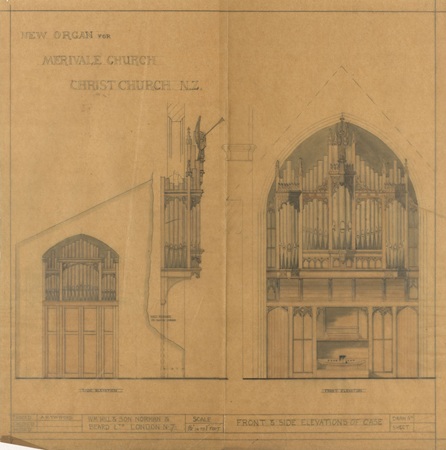
A technical drawing by the firm Hill, Norman and Beard of the front and side elevations of Merivale Church’s (Christchurch, New Zealand) organ. Reference: BOA Box 568.
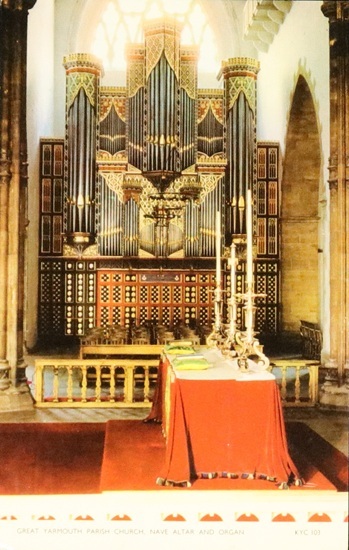
The front of a postcard addressed to Canon Arthur Gordon Westwood Paget (1893-1989), an Anglican clergyman and pioneer in organ conservation, showing the organ and altar at Great Yarmouth Parish Church. Reference: BOA Box 60 (Papers of Gordon Paget).
Currently, we have a single, substantial handlist which broadly describes the collection. Elliot aims to catalogue the archive in greater detail and precision, providing more information on groups of material or individual items to help students, staff and researchers identify what they want to see.
The British Organ Archive Project is the latest in a line of archival projects we at Cadbury Research Library have undertaken over the last 15 years to make our collections more accessible. These include projects such as the Stuart Hall Archive, the papers of former Prime Minister Anthony Eden, Lord Avon, the YMCA Archive, the Youth Hostel Association Archive (YHA), the Save the Children Fund Archive (SCF), the records of Toc H (an international Christian movement which developed from a soldiers’ rest and recreation centre named Talbot House), and the Noël Coward Collection, which relates mainly to Coward’s literary career.
2026 Instagram highlights so far
In Februarywe celebrated LGBTQ+ History month with posts on four iconic figures from the community.
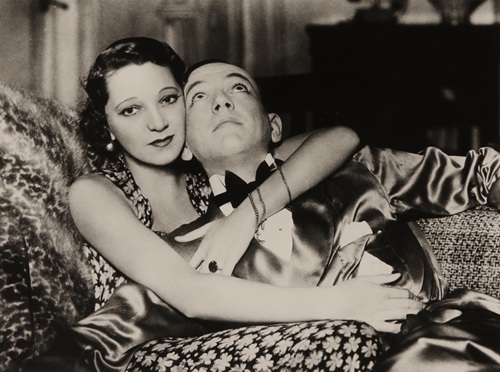
Noël Coward and Gertrude Lawrence in a production of Private Lives at the Phoenix Theatre, 1930 (COW/4/J/3/5).
In March, we celebrated Women’s History month with the stories of four inspirational women and held our International Women’s Day talk.
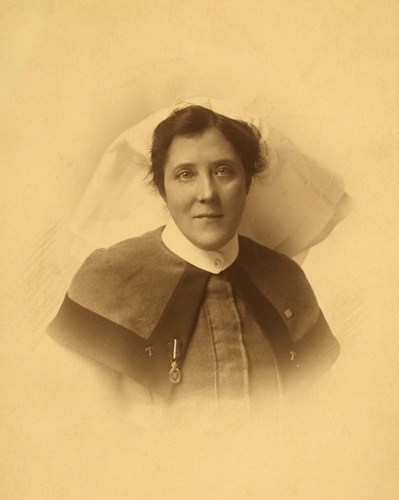
Photograph of Kathleen Lloyd in nurse's uniform, c.1908 (MS44/2/1).
Also in March, we marked Neville Chamberlain’s birthday with a look at some of his personal belongings.
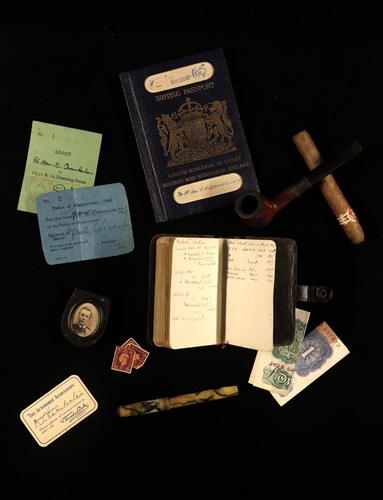
A selection of Neville Chamberlain's personal effects (NC2/29/37 and NC16/22).
And in April we marked the 100th birthday of Queen Elizabeth II, and her visits to campus through the years.
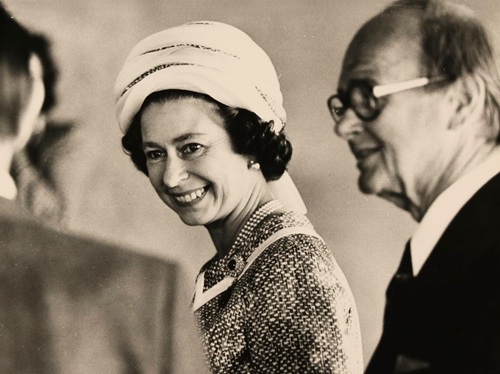
HM Queen Elizabeth II and University Chancellor Sir Peter Scott, 27 June 1975 (UA10/19).
Follow us on Instagram at @cadburyrl