This collection was given to the University of Birmingham Shakespeare Institute in 1964 by Marion Harry Spielmann’s son, Dr Percy Spielmann. It consists of an unpublished typescript, research notes, playscripts, draft manuscripts, correspondence, news cuttings and other items relating to Marion Spielmann’s project 'Shakespeare Treads the Boards', in which he sets out to compile a bibliography of plays in which Shakespeare appears as a dramatic character, as well as collecting as many scripts relating to those plays as he could locate. The collection was accumulated over the first decades of the twentieth century, and the findings finally compiled around 1953 by Percy Spielmann and bookseller, Alfred Reed, when it was bound into the unpublished bibliography ‘Shakespeare Treads the Boards’, which forms the heart of this collection.
Marion Harry Spielmann (1858-1948) was a well-renowned and prolific Victorian art critic and scholar. Described as one of the most influential and prominent intellectual figures of his time, he exchanged correspondence with artists such as Holman Hunt and John Millais as well as leading literary figures such as John Ruskin.
After leaving university, he established himself as an art journalist, writing for many leading journals including the Pall Mall Gazette and the Illustrated London News. He was a regular contributor to the Dictionary of National Biography and the Encyclopaedia Britannica, and engaged in lively intellectual correspondence through the pages of the Times Literary Supplement. From 1887-1904 he edited the Magazine of Art. However, his views on art were traditionalist, and he was unable to accommodate changing tastes that were enthusiastically embracing new movements such as Impressionism and Cubism, and consequently sales of his magazine dropped disastrously, and he was forced to close it down. He eased himself out of the art world and turned instead to a career of writing and lecturing.
It is clear that it was Spielmann’s intention to publish this research. In his apparently endless pursuit to track down all such plays, he wrote in one letter in August 1930 that ‘I am making a large collection of plays of this kind … and about which I am hoping to write a book’. Why this never happened is a matter for speculation, but Spielmann was ninety years old when he died in 1948, and it is possible to detect from his correspondence that encroaching old-age and ill-health hindered the finishing of the project. As did the fact, mentioned in the Foreword and discussed in a number of letters, that much of his work was destroyed by enemy action during the war, which must have been completely soul-destroying. There is also a sense, although not specifically articulated, that there was a slight obsession with finding just one more play. As the collection increased from around 35 plays in the 1920s to a list of over 300 by the 1940s, it seems that still the collection was never felt to be ‘complete’.
Marion Spielmann collected notes and scripts over many years, as the files of correspondence show, with letters to people all over the world requesting plays, information about plays and general enquiries all relating to his project. He was aided for much of this time by Alfred A. Reed, a bookseller specialising in Shakespeareana who ran his business from a small shop in St Martin’s Lane in London, with whom he began a correspondence in 1931. Reed took it upon himself to offer his assistance to Spielmann in his research and he assiduously pursued searches for plays, checked information and made suggestions of his own. As noted above, much of their work was lost during the war – in several letters in the collection, Reed expresses his sympathy and sadness that the bulk of Spielmann’s library has been destroyed by enemy bombs (DSH10/6/3/2/7 and DSH10/6/3/2/10), and then mentions that many of his own books have also been lost. He remarks that it will be difficult to replace the material during the world-wide conflict. Nevertheless, he asks for permission to proceed with the project and in 1941 he proposes a methodology for collating all the extensive data now collected, before compiling the book. At some point over the next few years, Percy Spielmann took over from his father in the administration of this project, but he relies heavily on Reed to help him finally complete the bibliography. Percy is generous in his acknowledgement of Alfred Reed's contribution to the work in his Foreword to the unpublished 'Shakespeare Treads the Boards', writing ‘When age limited his [father’s] energies, his very considerable researches were continued by Mr A. A. Reed, one of the more scholarly of booksellers’.
However, the war and its aftermath left Reed in straitened circumstances and he was forced to move to the Southwest and take a job as a kitchen porter in a hotel, ‘honest work however incongenial’. At this point, he writes to Spielmann explaining that he is unable to work on ‘Shakespeare Treads the Boards’ any longer (DSH10/6/3/8/1). He offers to send the work he has done so far on completing the manuscript to Percy, who proposes to buy the material and the rights from Reed for £100. At the time, this was probably a reasonably generous sum – Percy seems genuinely distressed to hear of Reed’s reduced circumstances (DSH10/6/3/8/2). Reed accepted the offer, and the material was dispatched by train back to London. However, Percy continued to involve Reed in the compilation, asking for his advice and clarification throughout. In April 1949, Percy Spielmann writes to Alfred Reed confirming that ‘Shakespeare Treads the Boards’ is nearing completion and he encloses a draft of the Foreword for his comment. Reed replies that it is ‘admirable (DSH10/6/3/11/28 and /29).
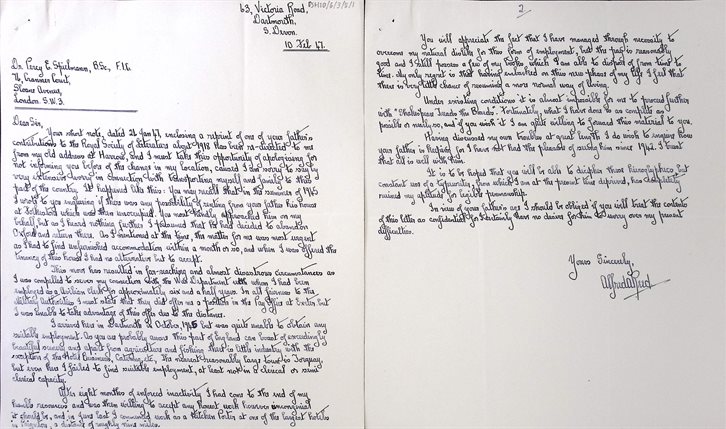
Letter from A. A. Reed to Dr Percy Spielmann 10 February 1947 DSH10/6/3/8/1
However, it is clear that Percy Spielmann was having difficulty in finding a publisher, ‘due to the present conditions’ (in post-war England), and regrettably, the completed work was never published as intended.
But, as is self-evident, the collection did eventually come to be held at the Shakespeare Institute Library, thus fulfilling Marion Spielmann’s hope, expressed in a letter of February 1931, that his collection of plays would 'in due time find its way into one of our great Shakespeare Libraries’. (DSH10/6/2/2/9)
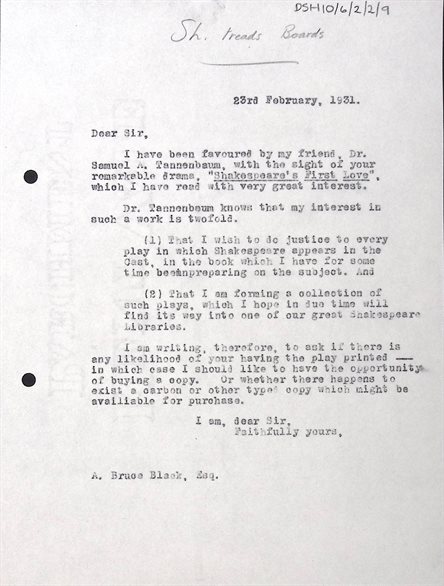
Letter from Marion Spielmann to Bruce Black, 23 February 1931 DSH10/6/2/2/9
The Collection
As well as the unpublished bound volume and its draft pages, the collection consists of four boxes of material, comprising:
A set of 329 pages of notes on the plays which eventually found their way into the bibliography, one page per play, arranged alphabetically by author. The numbered pages correspond to the entries in the final version of the volume, although a few are missing. Although all the pages follow the same format, some contain considerably more detail than others. It is almost certain that these are the notes compiled by Alfred Reed and referred to in his letter to Percy Spielmann of 20 August 1947 (DSH10/6/3/8/6).
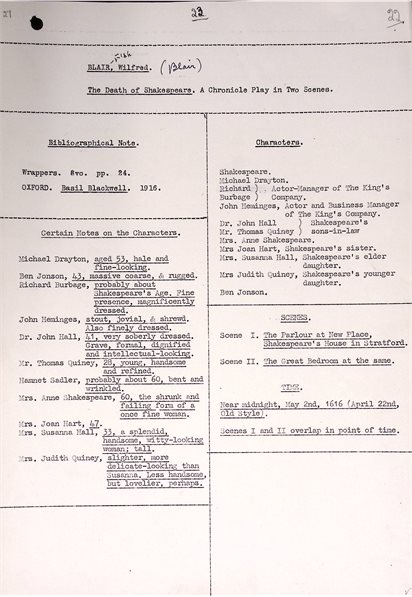
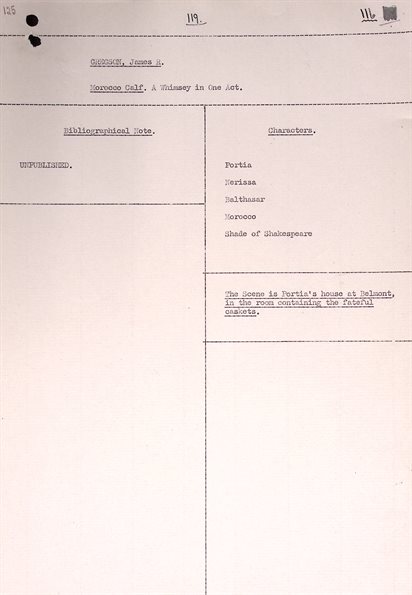
Pages 27 and 125 showing examples of notes for ‘The Death of Shakespeare’ by Wilfred Blair and ‘Morocco Calf’ by James Gregson. DSH10/2/1
There are three small booklets containing Marion Spielmann’s handwritten research notes for ‘Shakespeare Treads the Boards’, with further notes written on scraps of paper, inserted within the pages. There are also many lists of plays, arranged in a variety of different ways including various notebooks and lists of plays, which all contain much of the same information, but differently arranged – by title, by author, chronologically, by language, by genre – and so on. These have been continually updated, annotated and added to as new information was gathered.
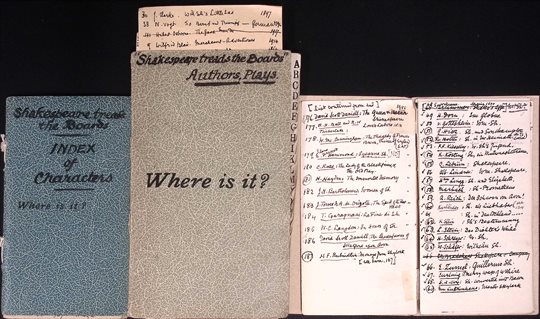
Three of Marion Spielmann’s research notebooks. DSH10/3/2
There are also notes on Radio plays, a late addition to the collection, mostly initiated by Reed, including plays by Clemence Dane, David Scott Daniell and Arthur Miller. However, it seems that Spielmann was not really taken with this new-fangled technology – and he flatly refused to allow any films to be included in his collection.
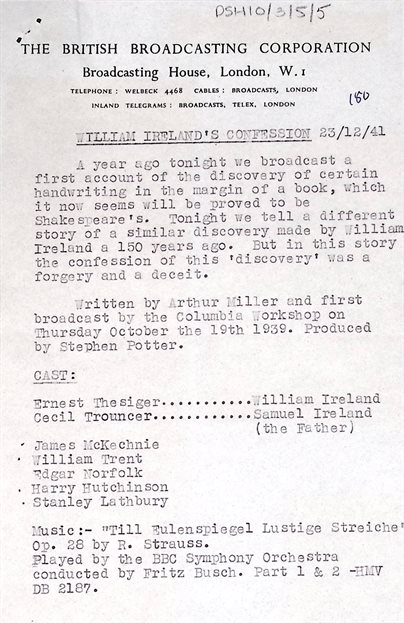
Details of a radio play, ‘William Irelands’s Confession’ by Arthur Miller, provided by the B.B.C. DSH10/3/5/5
This section also includes a selection of playbills from performances of some of the plays listed by Spielmann. These offer another aspect to the collection, placing the performances in a time and place, with accompanying advertisements and public notices, including instructions on what to do in the event of an air raid.
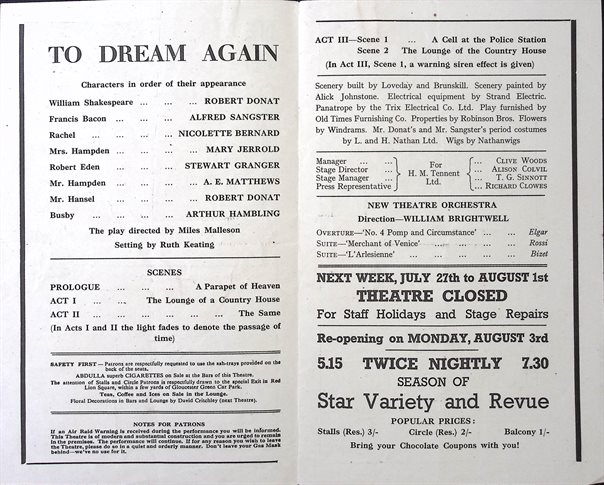
Programme of a performance of ‘To Dream Again’ at the New Oxford Theatre, 20 July 1942, with Robert Donat as William Shakespeare DSH10/6/3/4/12A
A small number of news cuttings including reviews of plays, letters to the Editor, Radio Times listings and so on, all form part of this collection.
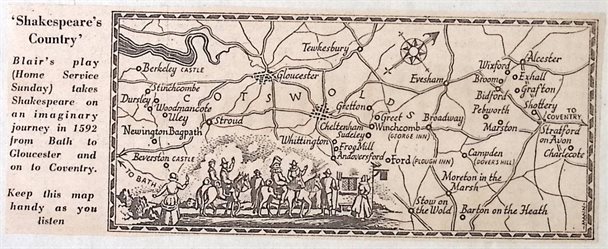
Radio Times listing for ‘Shakespeare’s Country’ by Wilfred Blair, 27 June 1947 DSH10/7/3/8
There are copies in this collection of 22 of the playscripts gathered by Spielmann, including the accompanying correspondence involved in obtaining it. Often the plays only existed in manuscript form, and sometimes there was only one copy, so Spielmann would request to borrow the text, have it typed or retyped, then return the original to the author. Sometimes he would send a second typed copy to the author, as they did not possess one. Considering the number of plays that are mentioned in the correspondence by Spielmann, not just requested, but as actually having been received, it is surprising that they number so few in this collection. Some were received as print books, rather than scripts, but as for the rest, they must have been a part of the collection that was lost during the war.
The last item in this section is an opera score ‘Shakspeare!’, accompanied by a letter in French which confirms that the title character is a dog ‘of extraordinary intelligence’, called Shakspeare!
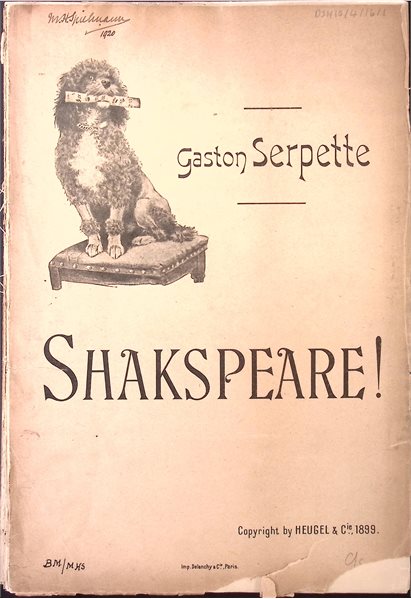
Opera, starring a dog called Shakespeare! DSH10/4/16
A journal article by M. H. Spielmann, ‘Shakespeare as a dramatic character’, published in Recent German Books in 1931 (DSH10/5) continues this theme. After explaining the genesis of his project some ten years ago, and its progress so far – at that point in time, Spielmann had identified over 100 plays in which Shakespeare appears as a dramatic character - he sets out his parameters for inclusion within this definition: as well as appearing as a speaking character on the stage, it could also include ‘Shakespeare as an infant, as a dying man, and as a corpse … as a ghost; or again as a statue, speaking, or standing, in stoney silence’. Or, as we have seen, a dog. This is quite a broad definition!
Over thirty years of correspondence trace Marion Spielmann’s quest to find as many plays as he could to add to his collection. His letters run from 1923 to around 1942, at which point Alfred Reed and then Percy Spielmann take over much of the correspondence. The letters reveal that Marion was a well-known and well-respected scholar, and he had contacts all over the world including Dr Samuel Tannenbaum, editor of the Shakespeare Association Bulletin in New York, and Mr H. Howard Furness Jr, another American Shakespeare scholar who was also collecting plays. He writes to the Spanish Embassy enquiring after a Spanish play by Enrique Zumel, to no avail, although he did eventually manage to track down a copy in the Birmingham Public Library. He writes to other libraries all over the world as well as booksellers and publishers in Germany, Holland and all over the UK. He also approaches the authors of the plays themselves, many of whom were surprised and flattered that he had heard of their unpublished plays, as well as actors who have appeared in productions of the plays, and the theatres where they were performed, seeking information about other cast members and scripts.
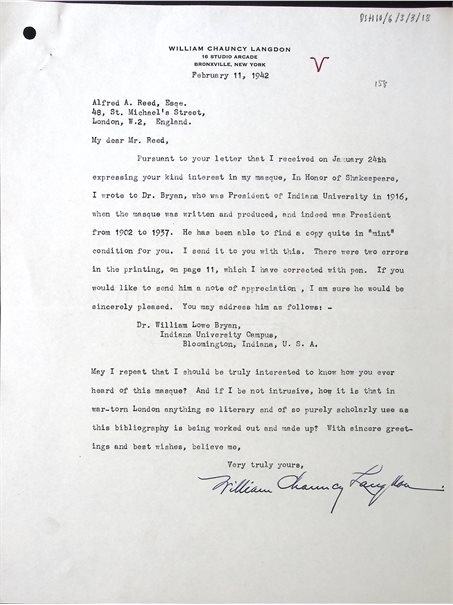
Letter from William Chauncey Langdon in New York, to Alfred Reed, 11 February 1942, expressing surprise that such academic work was still carrying on in ‘war-torn London’. DSH10/6/3/3/18
All avenues were explored, no stone left unturned. What is interesting is that Spielmann’s concern was solely in identifying the plays and adding them to his bibliography. He appears to take no interest in actually seeing or listening to the plays, or in passing any opinion on their merit. In his biography of his father, Percy Spielmann observes that ‘he was more interested in Shakespeare on the printed page that on the stage’ and this is certainly borne out in the correspondence in this collection.
The final letter in the collection was only found recently, and by chance, but it makes a very satisfying conclusion to this story. From the Vice Chancellor of the University of Birmingham, Robert Aitkin, to Percy Spielmann, it thanks Dr Percy Spielmann for the gift of books and papers to the Shakespeare Institute on the occasion of the four hundredth anniversary of Shakespeare’s birth (1964), noting that the typescript of ‘Shakespeare Treads the Boards’ and accompanying papers will be a ‘valuable addition to the Institute’s holdings’. It also of course, as mentioned above, fulfilled Marion Spielmann’s wish that his collection should one day find its way to one of the great Shakespeare libraries.
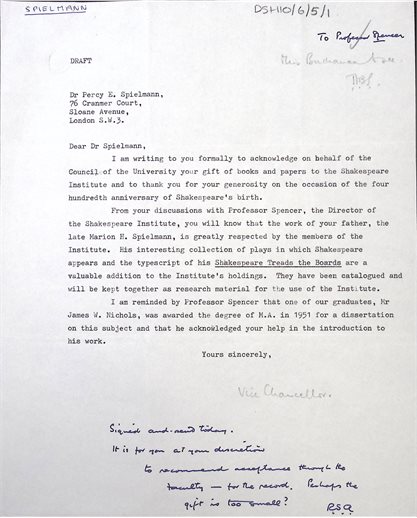
Letter from Robert Aitkin, Vice Chancellor of the University of Birmingham to Dr Percy Spielmann DSH10/6/5/1
All this material is available for viewing at the Shakespeare Institute Library, Stratford-upon-Avon.
In addition, where they were available, Spielmann also collected plays as printed books – these number around ninety books and are currently housed at the Cadbury Research Library at the University of Birmingham.
James Nichols’ thesis, William Shakespeare on the Stage: An Historical and Critical Study of the Figure of William Shakespeare in British and American Drama, 1951, which acknowledges Percy Spielmann’s generosity in allowing him to consult his father’s research, is available to be consulted at the Shakespeare Institute Library.
Dr Percy Speilmann’s biography of his father, ‘Art, Books and Friendships of Marion H. Spielmann, F.S.A. 1858-1948 by his son Percy E. Spielmann, Ph.D., B.Sc., F.R.S.L.’ is held at the National Art Library, Victoria and Albert Museum, MSL/1976/6348/1.