The Arbury Hall Connection
Trevor Howard-Hill encountered the little-known collection known as the Arbury Plays and worked on them intermittently during his career. His experience shows the difficulties faced by academic researchers: finding areas ripe for research, dealing with access to private collections requiring research grants and international travel and staking claims to unedited plays.
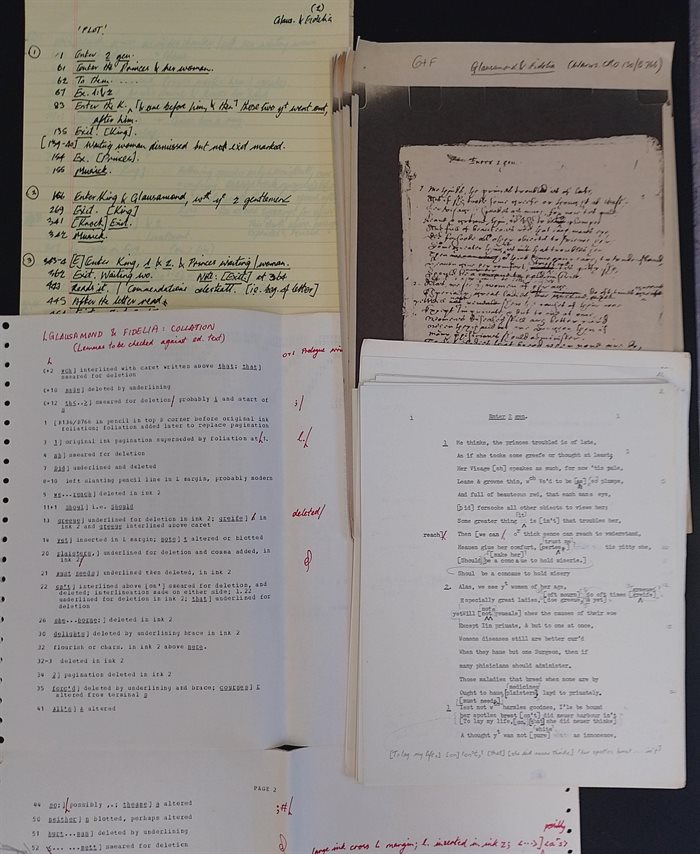
‘Glausamond and Fidelia’: page of notes, facsimile of manuscript, annotated typescript and computer-generated text. DSH13/12/3.
The Arbury Plays are a collection of manuscript plays collected by John Newdigate (1600-1643), a lawyer, member of parliament and poet who lived at Arbury Hall near Nuneaton in Warwickshire.
The earliest published reference to the Arbury Plays seems to be a cryptic reference in The Gentleman’s Magazine in April 1906: ‘I have now before me a seventeenth-century MS. volume from a Warwickshire library (“but I did not tell you where, my boys,” as the Lincolnshire poacher slyly sang). I have read only one piece – The twice chang’d friar – with any care’. The anonymous writer goes on to describe the plot of the play.
Howard-Hill appears to have first encountered the plays in 1979 on sabbatical leave from his post at the University of South Carolina which he spent in England attempting to view every pre-1640 dramatic manuscript in existence. He intended to publish a book provisionally titled Manuscript, Text and Performance about how a Renaissance play was transformed from a manuscript to the stage. He saw a single manuscript play from Arbury Hall, Glausamond and Fidelia, at the Warwickshire County Record Office. It is considered to be the earliest surviving example of ‘foul papers’ of an English play, that is, a copy with corrections and deletions by the author rather than a ‘fair copy’ which has been copied out again, sometimes by a scribe. Howard-Hill published an essay, ‘Boccaccio, Ghismonda, and its foul papers, Glausamond’ in Renaissance Papers in 1980 and indicates the potential for further research although he never produced an edition of the play.
Howard-Hill then heard about more Arbury plays from Paul Merchant at Warwick University. A student at Warwick had begun a PhD on the plays, particularly The Twice-Changed Friar but did not finish it. The plays had been ‘found’ again in 1976 by Peter Beal presumably when researching his Index of English Literary Manuscripts but the Newdigate family apparently refused permission to publish because they did not want the publicity. They did allow the plays to be microfilmed and catalogued by the Warwickshire County Record Office and deposited the original there on request.
The plays are: Baiazet and The Twice-Changed Friar (both plays have titles in the manuscript). The other plays lack titles so Howard-Hill called them: Ghismonda and Guiscardo (a version of Glausamond and Fidelia); The Humorous Magistrate; and The Emperor’s Favourite.
Howard-Hill also believed that John Newdigate was not only the collector of these plays but the author. He set out his argument in ‘Another Warwickshire playwright: John Newdigate of Arbury’ in Renaissance Papers 1989.
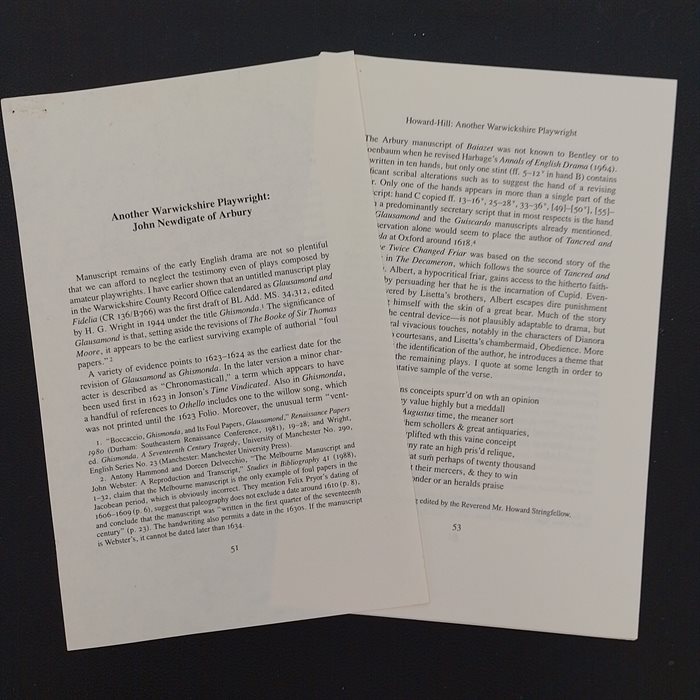
‘Another Warwickshire playwright: John Newdigate of Arbury’ by Trevor Howard-Hill, an offprint from ‘Renaissance Papers’
Howard-Hill drew on the research of Vivienne Larminie who completed a PhD at the University of Birmingham in 1980 on the figure of the seventeenth-century gentleman with particular reference to the Newdigates at Arbury. He wrote to her in 1988 saying that he was trying to finish a manuscript he had been working on for some time (presumably Thomas Middleton’s A Game at Chess which he edited) but that he hoped to return to the Arbury plays once that was finished.
In 1987 he entertained hope that the RSC would perform a world premiere of The Humorous Magistrate at the Swan Theatre in Stratford.
His work allowed Sylvia Wagonheim to update entries on the Arbury plays in her 1989 revision of The Annals of English Drama 975-1700 edited by Alfred Harbage.
In 1991 he was approached by Margaret-Jane Kidnie, then a student at the Shakespeare Institute in Stratford, looking for a PhD topic and keen to work on one of the Arbury plays, given its local interest. Howard-Hill warned her off, citing his plans to publish. The Institute Director, Professor Stanley Wells, also wrote to ask if he had a publishing contract in place already. Howard-Hill then replied to Professor Wells to complain privately that he felt he had been granted exclusive permission by Lord Daventry (then owner of Arbury Hall) to work on the plays and was surprised he hadn’t told Kidnie this. He stressed the fact that his university had invested considerable sums giving him a sabbatical and a research grant, and complained that he felt at a disadvantage and couldn’t compete with a PhD student’s free time while he had so many other commitments.
Professor Wells replied to let him know that Kidnie had certainly obtained Lord Daventry’s permission. He also casually added that he had spoken to Lord Daventry ‘last week at the Shakespeare Centre’ and he said he had not been aware that Howard-Hill was still working on the plays.
Margaret-Jane Kidnie directed her research elsewhere but Howard-Hill never did publish editions of the plays.
There was a final twist in the tale: in 2005 academics from the University of Calgary, Canada, held a symposium to present their research on an untitled manuscript play discovered in their archives. This included a performance by some drama students. They had titled it Marriage Upon Marriage, or, As I Told You Before but one of the select group invited to attend the symposium recognised it as a version of The Humorous Magistrate. The person fortunately invited was Margaret-Jane Kidnie. The play had its world premiere after all and Kidnie published an edition for the Malone Society in 2012.