Our internationally important collection includes approximately 305 metres of recent and historical auction catalogues mostly by Christie's, Sotheby's and Foster's, with some by Bonhams and Phillips. The Christie's and Sotheby's catalogues date back to the eighteenth Century and run until 2020 when publication of the printed catalogues ceased. Many of the catalogues give details of the price each lot was sold for, either by hand-written notes at the time of the sale or by the addition of a printed slip after the sale. There is a small number of European, North American and Asian sales.
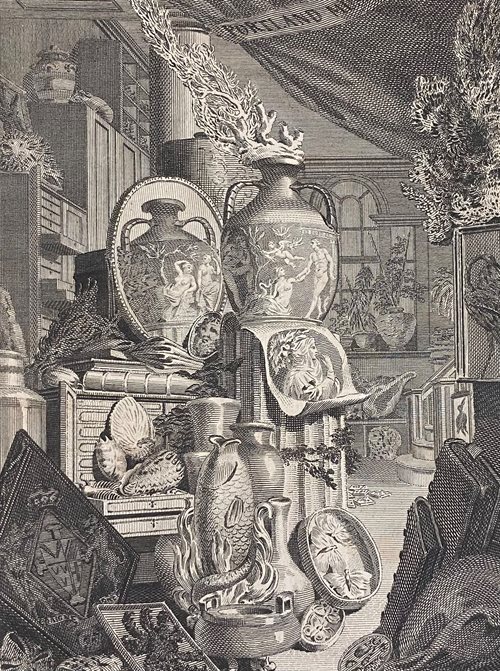
Frontispiece to 'A catalogue of the Portland museum, lately the property of the duchess dowager of Portland...' (1786)
Using auction catalogues
The detailed study of sales catalogues gives access to centuries of data concerning the rise and fall in popularity and price of art works and other collectable objects. Sales catalogues can be used to:
- Establish the value of an artist's work at a given time
- Establish the provenance, i.e. ownership history of a work of art
- Find illustrations
- Find details about an artwork such as dimensions
- Identify trends in the history of collecting and economic conditions
The earliest sales catalogues are generally simple pamphlets with basic information about the lots.
A few, such as the catalogue to the sale in 1786 of the natural history and art collection of Margaret Cavendish Bentinck, Duchess of Portland (1715 –1785), which included the famous Portland Vase, and lasted thirty-eight days, stand out because they were substantial publications reflecting the size and importance of the sale.
A small number of catalogues from the eighteenth and nineteenth centuries have illustrations but it was not until the advent of photography that illustrated catalogues become commonplace. In some cases, a photograph of an object in a catalogue might be the only published image.
Requesting auction catalogues
The catalogues are kept in closed storage. Most are not listed on FindIt@Bham except for a small number of catalogues from the eighteenth century.
To find out if we have a catalogue and to make an appointment to see it please contact
fine-arts-library@contacts.bham.ac.uk with as much information you can give us about the catalogues you want, and staff will check to see if we have a copy. If you can, please give the following information:
- Name of auction house
- Date of sale
- Name of sale, if known
- Place of sale, e.g., London
- Lugt number, see Guides to sales catalogues for more information
Lugt's Repertoire des Catalogues de Ventes Publiques
The Repertoire des Catalogues de Ventes Publiques compiled by Fritz Lugt, known simply as Lugt, lists sales catalogues between published 1600-1925. A reference copy of Lugt, marked up to indicate Barber Fine Art Library holdings, is kept for consultation behind the Reception Desk. The information in Lugt has not been updated and cannot be taken as an accurate listing of our entire collection, however it is the nearest we have to a catalogue and gives an idea of the range of material we hold. Please ask staff you wish to consult our copy.
If you are a member of the university you can also search a revised edition of Lugt using Art Sales Catalogues Online, but we do not have access to the digitised catalogues, and the information about our holdings might not be accurate.
Until 2010 Barber Fine Art Library staff maintained a Vendors’ Index by obtaining the names of sellers from the sales catalogues we received every month and listing the lots they were selling. This enabled researchers to establish the provenance of a work of art. Today, anybody requiring information like this would mostly check online databases such as those maintained by the Getty Research Institute.
The set of drawers containing the index is a notable feature of the reading room.