A roundup of some of the work done by students and staff using the University’s special collections in 2024.
Lost text rediscovered
A fifteenth-century manuscript held by Cadbury Research Library, MS335, thought to be German is actually Polish, a University of Birmingham PhD student has found.

Anna Packman
Anna Packman, using palaeographical and codicological analysis, ascertained that the medieval manuscript was probably produced by the Augustinian canons of Kraków, a city with a thriving university in the Middle Ages, and contains a Polish text previously thought lost.
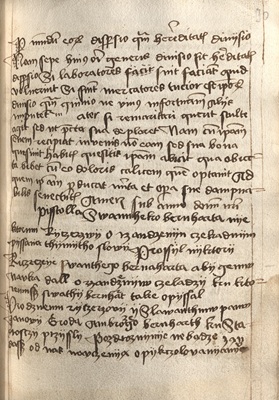
The start of the rediscovered Polish text on the new paragraph. MS335, folio 90.
This exciting discovery is a result of Anna's engagement with the original, physical item, kindly funded by a Midlands4Cities placement. Not only has Anna's work changed how we think about the manuscript but Anna credits seeing the item 'in the flesh' with helping to build her understanding of medieval manuscript culture more broadly.
The staff at Cadbury Research Library are indebted to Anna's work and thrilled that she's enjoyed and benefitted academically from consulting the library’s material.
A Book of Hours: holding history in your hands
The Cadbury Research Library holds many interesting and unique artefacts available nowhere else. And they can be useful to students seeking research insights that cannot be found in secondary literature, as Jo Birch, an MA International Heritage Management student, knows well and reflects on below.
"One such unique artefact is the Bridgettine Book of Hours, KWH/A/1, which was created in 1467. I found that through carefully handling this manuscript, I gained a greater understanding of it as a physical artefact, through its weight and texture, which further suggested ways in which the book might have been read or used; these are details that might not be found in the secondary literature.
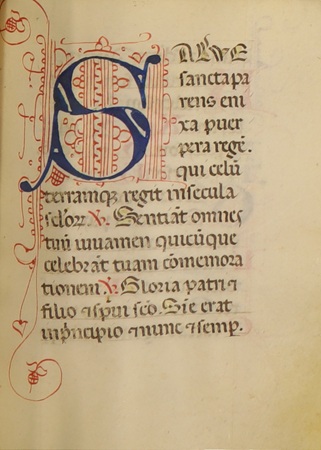
The beginning of the Mass in honour of the Virgin Mary. KWH/A/1, leaf 89.
"This is just one way in which seeing and holding the artefacts the Cadbury Research Library has allowed me to better understand the book or object. This is one of the great strengths of Cadbury Research Library and for that reason I recommend visiting the library to fellow students."
KWH/A/1 features in Cadbury Research Library’s List of medieval manuscripts, which is one of the library’s 22 online subject and resource guides.
Using the Church Mission Society archive
As part of his work on his thesis, Spencer Pennington, a University of California, Los Angeles (UCLA) History PhD candidate, spent six months in the Cadbury Research Library.
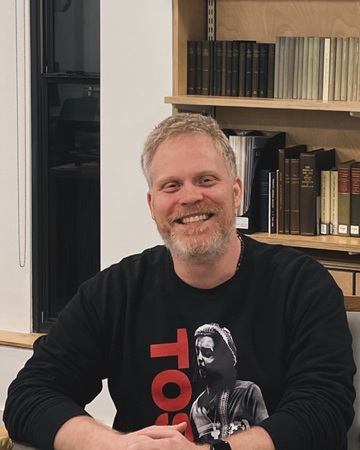
Spencer Pennington
"My project’s focus is on the Urdu-speaking Protestant Christians of British North India, circa 1854-1914, and this religious community’s shared language, culture, and history with the region’s Muslims and Hindus.
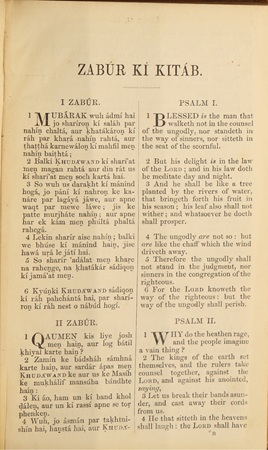
The first page of a Hindustani-English Book of Psalms. CMS_ACC644 Z2.
"The archives of the Church Mission Society, held at the Cadbury Research Library, proved invaluable. I found sources – in Urdu and English – written by and about these North Indian Christians which are unavailable anywhere else in the world, including materials that I thought had disappeared, or which I didn’t know existed!
"The library’s staff were so helpful. I thoroughly recommend contacting them to see what unique materials they have and if they can help you too."
The Church Mission Society's archive and Church Mission Society Unofficial Papers can be viewed on our archival catalogue.
Papers of a Prime Minister
Last year work on the papers of one of twentieth century Britain’s most prominent politicians, Anthony Eden, took place at Cadbury Research Library.
As Prime Minister, Britain’s wartime Foreign Secretary, Secretary of State for War in 1940 and the Secretary of State for the Dominions in 1939, Eden witnessed dictatorship and fascism in 1930s Europe, World War II, the early Cold War and the decline of the British Empire.
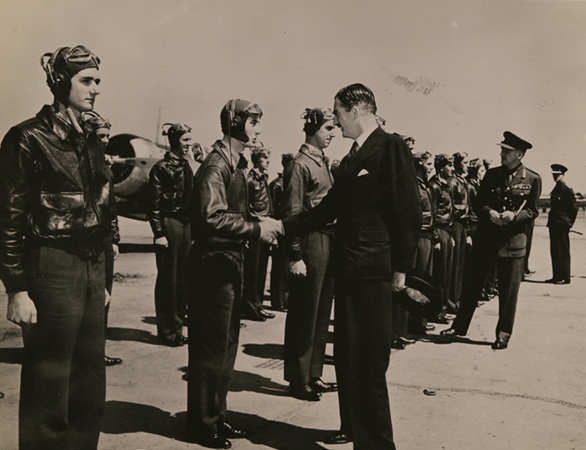
Eden inspecting RAF pilots during World War II. AP/5/1/2/657.
He also helped shape the international politics of the 1930s, 40s and 50s, opposing fascism and the appeasement of Germany and Italy, negotiating during wartime with the then USSR and America on the future of Europe, and dealing with the 1956 Suez Crisis as Prime Minister.
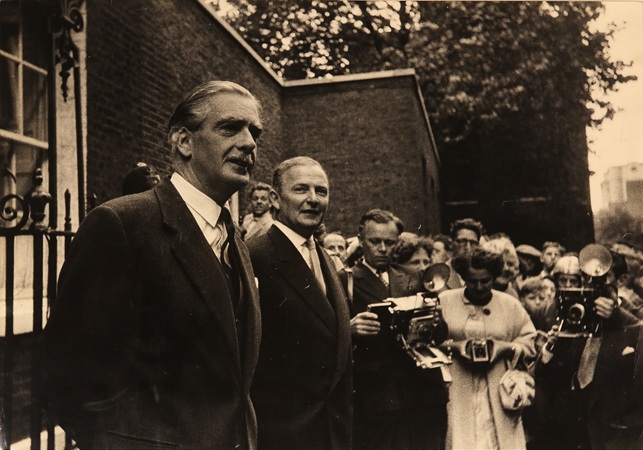
Press conference during the Suez Crisis. AP/5/1/3/270.
The archive includes Eden’s correspondence with Churchill and the Royal Family; his speeches and political diaries; papers about the elections he fought; constituency correspondence; thousands of photographs, including ones of Eden with UK and non-UK politicians; his personal papers; and much more for you to explore.
The Avon Papers: Personal and political papers of Anthony Eden, 1st Earl of Avon can be viewed on our archival catalogue. There is also Cadbury Research Library’s online exhibition Anthony Eden, 1st Earl of Avon and UK Prime Minister and Avon Papers Archive Project site and blog to explore.
Cataloguing Kelmscott
This year also saw work on the FindIt@Bham catalogue records of one of Cadbury Research Library’s fabulous named library collections, Kelmscott.
The Kelmscott Press (1891-1899) proprietors, William Morris and Emery Walker, modelled their beautiful designs on fifteenth-century books. And the most magnificent is arguably their edition of Chaucer’s works. Below is one of the book’s 87 illustrations, here announcing the start of ‘The Knight’s Tale’ from The Canterbury Tales.
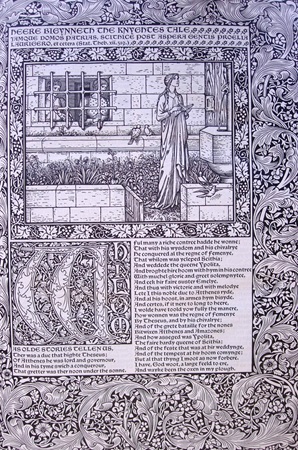
The start of ‘The Knight’s Tale’ from The Canterbury Tales (1896). f PR1850-1896.
As well as a copy of the Kelmscott Chaucer (f PR1850-1896), Cadbury Research Library holds Kelmscott editions of Shakespeare, Shelley, Tennyson and Ruskin, printings of Beowulf and The Golden Legend, works by Morris himself, and more.
To see a list of the Kelmscott books, go to FindIt@Bham, choose advanced search, select ‘On the shelves’, then the Cadbury option from the ‘Search Scope’ dropdown and change ‘Any field’ to ‘Author/creator’. Type “Kelmscott Press”, including the double quotation marks. Then hit the search button (top tip: sort results by ‘date-oldest’).
Some of Cadbury Research Library’s other named rare book collections are described online.
Celebrating Professor Stuart Hall
In October we reflected on the blue plaque unveiled in September at the Muirhead Tower entrance to commemorate the life and outstanding work of Professor Stuart Hall (1932-2014), posting images of the plaque and the man himself on Cadbury Research Library's Instagram.
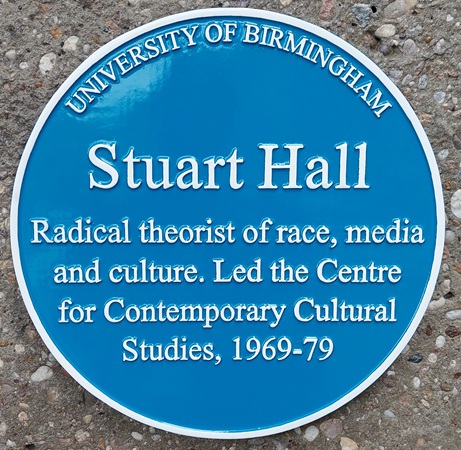
The Muirhead Tower blue plaque commemorating Professor Stuart Hall.
Professor Hall was key to establishing Cultural Studies as a discipline and central to the founding of the University’s Centre for Contemporary Cultural Studies in 1964. He was Director of the Centre from 1969-79 and was a leading public academic, coining the term ‘Thatcherism’, sitting on the Runnymede Commission on the Future of Multi-Ethnic Britain (1997-2000), and joining the Campaign for Nuclear Disarmament (CND) in 1957. His published research explored media, popular culture, race and politics.
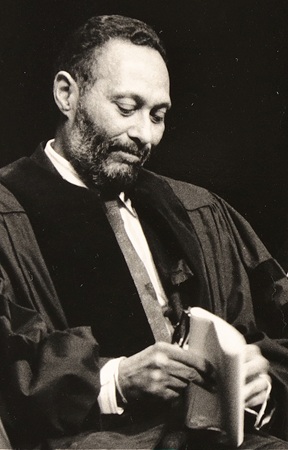
Stuart Hall at the Special Convocation held in his honour at the University of Massachusetts, 1989. US121/Box 84.
Hall’s academic, political, and social significance has led to the University instigating ‘The Stuart Hall Archive Project: Conjunctures, Dialogues, Readings’, of which the cataloguing of Hall’s papers at the Cadbury Research Library by the Stuart Hall Archivist is a crucial part.
The Stuart Hall Archive, which is one of the University of Birmingham Staff papers and part of the University Archive, can be viewed on our archival catalogue. There is also a Stuart Hall Archive Project website to explore.
More information
We at Special Collections welcome all visitors and enquiries. More information about Special Collections’ three sites: Cadbury Research Library, Barber Fine Art Library, and Shakespeare Institute Library.