Professor Nigel Harris - inaugural lecture
- Location
- Alan Walters Building - Room G11, Online - a link will be sent to you before the event
- Dates
- Wednesday 8 November 2023 (17:30-18:30)
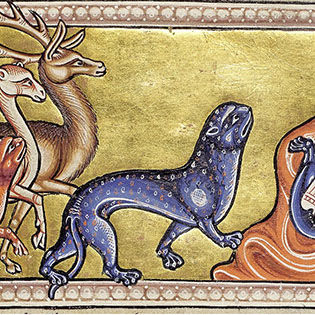
Studying Medieval Animals: The Case Of The Panther
Using numerous images and literary references (also to modern authors such as Kipling, Beirce and Rilke), this lecture will work towards constructing a cultural history of the medieval panther which takes account of both traditional and contemporary scholarly approaches – and which, as such, exemplifies a methodology that is potentially applicable also to the study of other species.
In a general sense, the lecture is a response to the current ‘Animal Turn’ – the heightened awareness of the importance of animals in the scheme of things that can be seen as pervasive in contemporary society. More specifically, however, it responds to the scholarly approach known as ‘Animal Studies’, which has foregrounded in a new way the subjectivity, perspectives and agency of animals – by no means only, but also, as they appear in literature.
My own work on animals has been heavily indebted to a distinguished tradition within medieval German studies that has focused particularly on their allegorical uses – that is to say, contexts in which an animal’s prime function is to convey meanings or messages about God and/or mankind. The panther, for example, which was believed with monumental inaccuracy to be the possessor of sweet-smelling breath, was presented by many medieval authors as symbolizing the sweetness – and, hence, grace and mercy – of Christ.
That approach remains valid, but is no longer sufficient. We must also look at other factors. In the case of the panther, for example, we must consider what medieval people knew (or thought they knew) about real, actual panthers; we must consider depictions of encounters between panthers and humans, which sometimes daringly challenged the perceived ‘anthropomorphic difference’ between man and beast; and we must take account of the agency of literary panthers, as this is accorded to them by authors in spite of, or sometimes because of, their intrinsic animality.
In such ways the lecture will seek to combine older and newer scholarly methods in an attempt to exemplify the kind of sensitive and informed contribution that medievalists could make to the scholarly literature of the ongoing ‘Animal Turn’.
The lecture will be followed by a drinks reception.
Inaugural lectures are a landmark in academic life, held on the appointment of new professorships. You can learn more about our other forthcoming talks and view our archive of previous lectures on our CAL Inaugural Lectures webpage.