
Just 3% of the world’s glaciers account for over half of glacier ice loss
Glaciers ending in lakes, oceans or ice shelves lose 134bn tonnes of ice a year, with those ending in lakes losing ice 57% faster than those on land
Glaciers ending in lakes, oceans or ice shelves lose 134bn tonnes of ice a year, with those ending in lakes losing ice 57% faster than those on land
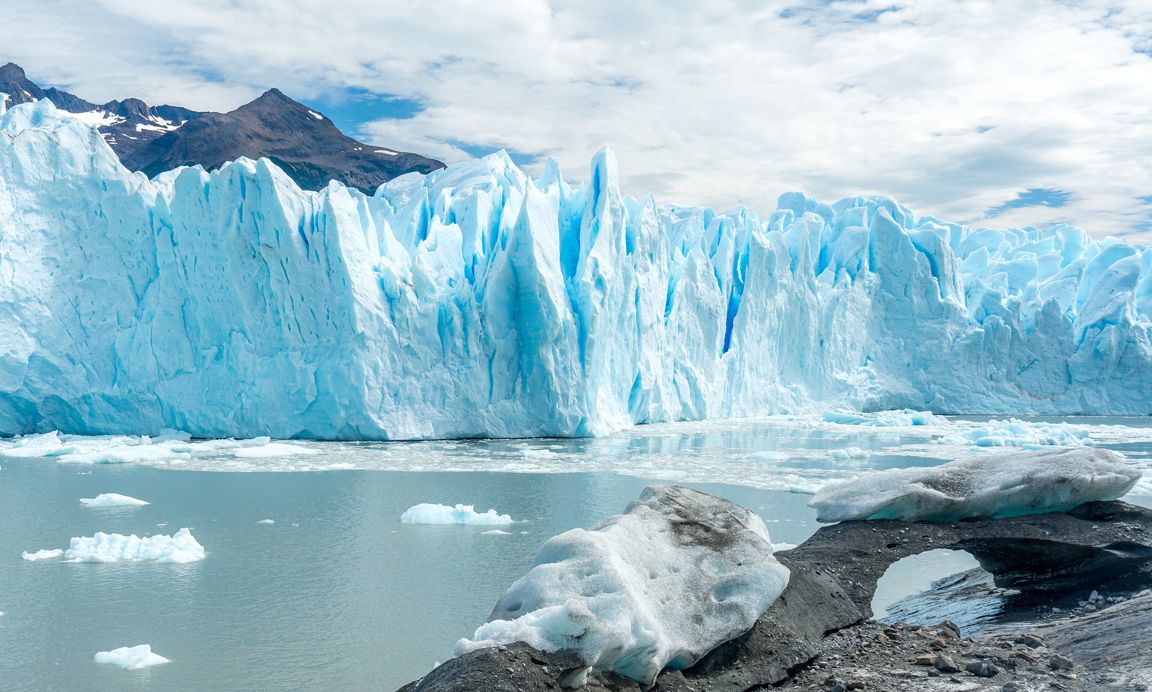
Glaciers like Perito Moreno Glacier in Argentina are losing significant mass each year, and much faster than other types of glaciers. Picture credit: Fernando
Glaciers ending in lakes, oceans or ice shelves make up 3.2% of the world’s glaciers, but lost 134bn tonnes of ice each year between 2000 and 2019, accounting for more than half of all glacier ice loss, a new study shows.
The team of environmental scientists found that these glaciers tend to be much larger than those ending on land, together covering more than half of the world’s glacier area. But for glaciers ending in lakes, size isn’t the whole story.
Publishing their findings in Nature Communications, the researchers found that glaciers ending in lakes lost ice around 57% faster, relative to their size, than those ending on land over the same period.
The study was led by scientists from the University of Birmingham and the University of Leeds. The team examined 216,502 glaciers worldwide, excluding the Greenland and Antarctic ice sheets, to identify which end in lakes, adding to existing records of those ending on land, in oceans or in ice shelves. They then compared ice flow and ice loss across all four glacier types.
The last decade has seen a huge increase in the global glacier and climate data available to researchers. Bringing these datasets together lets us compare how glaciers in different settings are behaving. As more glaciers shift from one setting to another, understanding those differences will only become more important.
Many of the models used to project glacier change don’t yet fully account for glaciers ending in lakes. The team’s new glacier classification could help address this, enabling other researchers to improve projections of sea-level rise, water resources and natural hazards.
Dr Joe Mallalieu, who conducted the research at the University of Birmingham and is now based at the University of Leeds, said: “Glaciers ending in lakes really stand out: they’re losing ice particularly quickly. We don’t yet know exactly why. It could be the lakes themselves, the size and shape of the glaciers, or a bit of both. Untangling that is the next big question, especially as glacier lakes are becoming more common in a warming climate.”
Lakes can affect glaciers in several ways that may contribute to this higher ice loss. Lake-ending glaciers can lose large chunks of ice from the glacier front as icebergs, a process known as calving, and lake water can melt the ice below the waterline, both helping to speed up ice loss.
After accounting for factors such as climate, glacier size and elevation, the analysis revealed two key differences: glaciers ending in lakes and oceans flow on average 10% and 44% faster than those ending on land, respectively, and lake-ending glaciers lose around 57% more ice than land-ending glaciers, relative to their size.
Lake-ending glaciers were present in every major glacier region of the world, and in most regions they were losing ice faster than glaciers ending on land or in oceans.
A growing number of glaciers are changing type as the climate warms: ocean-ending glaciers are retreating onto land in parts of the Arctic, while worldwide, the growth of glacier lakes is turning some land-ending glaciers into lake-ending ones. The study’s results suggest these shifts could have contrasting effects, with glaciers retreating onto land likely to slow down, while those newly ending in lakes could lose ice faster.
Dr Nicholas Barrand from the University of Birmingham said: “The last decade has seen a huge increase in the global glacier and climate data available to researchers. Bringing these datasets together lets us compare how glaciers in different settings are behaving. As more glaciers shift from one setting to another, understanding those differences will only become more important.”
For media enquiries please contact Tim Mayo, Press Office, University of Birmingham, tel: +44 (0)7815 607 157.
Reference: Mallalieu, J. et al. (2026). ‘Global-scale variability of glacier velocity and mass loss across terminus environments’. Nature Communications. https://doi.org/10.1038/s41467-026-78654-y
Dataset: The global glacier terminus classification and associated data are freely available on Zenodo.
Funding: This research was supported in part by the Leverhulme Trust and the UKRI Canada-Inuit Nunangat-United Kingdom Arctic Research Programme (IMAGINE project).

Associate Professor of Glaciology
Dr Nicholas Barrand is a glaciologist specialising in mass balance and dynamics of the Earth's glaciers and ice sheets.
Research Fellow
Dr Joseph Mallalieu is a glaciologist, specialising in contemporary glacier and ice-sheet dynamics, and how these are influenced by a range of phenomena, including climate change, ice-marginal lakes and volcanism.
