

Cold Atoms
Welcome to the coldest place in the UK!
When cooled to temperatures near absolute zero, atoms unveil their wave-like nature and quantum mechanical laws replace those of classical mechanics. By using finely controlled lasers and magnetic fields, scientists of the Cold Atoms group are able to cool small ensembles of atoms down to the lowest temperatures in the universe – just a few billionths of a degree above absolute zero – and thus to access the realm of fully quantum mechanical motion.
All the essential parameters of the atomic samples, including the motion, the shape, and the forces between the atoms can be efficiently controlled, making these ideal systems for discovering new quantum behaviour and new states of matter. The Cold Atoms Group exploits these exceptional systems to study a number of quantum phenomena.
The Cold Atoms Research Group was set up during 2008 and is part of the Midlands Ultra Cold Atoms Research Centre (MUARC) together with the University of Nottingham.
Scientists of the Cold Atoms group in Birmingham are leading the national Quantum Technology Hub for Sensors and Metrology that has the aim of exploiting the exceptional properties of quantum matter to realise real-world applications like ultra-precise atomic clocks and interferometers and ‘gravitational cameras’ which can unveil the underworld – from modern urban infrastructure to the buried secrets of Stonehenge.
Research
Quantum Optics and Photonics
Quantum Optics and Photonics
We use 4-wave mixing in a rubidium vapour to generate beams that are entangled in their quadratures as well as in their transverse spatial degrees of freedom. These light fields, dubbed "quantum images", have subtle quantum correlations in their phases and their amplitudes that depend on the position in their transverse profiles. They could be used for the imaging of hard to see (transparent) objects, accurate beam positioning, or quantum cryptography.
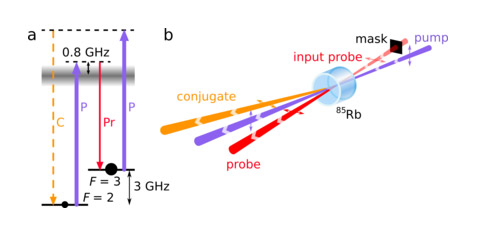
We have recently generated squeezed light beam that displays noise lower than the shot noise in 75 independent regions or “locales” along its transverse profile [3]. This localised multi-spatial-mode (MSM) quadrature squeezing can be used to improve resolution of optical imaging
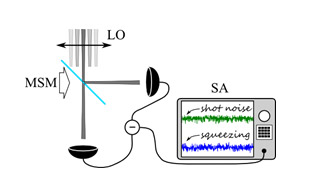
The homodyne detection of the MSM quadrature squeezing works by scanning the position of the local oscillator (LO). This allows the mode structure mapping of the MSM squeezed vacuum.
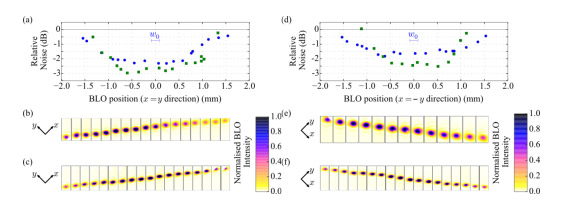
Observation of localised quadrature squeezing for two orthogonal scans of the LO positions (left and right). The squeezing as a function of the LO position is shown in (a) and (d) for two diameters of the LO beam, circles (narrower LO) and squares (wider LO). The images in (b) and (e) correspond to the squares and circles in the graph.
References:
- C. S. Embrey, J. Hordell , P. G. Petrov, and V. Boyer, Optics Express, 24, 27298–27308, (2016). doi:10.1364/OE.24.027298
- X. Zang, J. Yang, R. Faggiani, C. Gill, P. G. Petrov, J-P. Hugonin, K. Vynck, S. Bernon, P. Bouyer, V. Boyer, and P. Lalanne, Phys. Rev. Applied , 5, 024003, (2016). doi: 10.1103/PhysRevApplied.5.024003
- C. S. Embrey, M. T. Turnbull, P. G. Petrov, and V. Boyer, Phys. Rev. X, 5, 031004, (2015). doi:10.1103/PhysRevX.5.031004
- M. T. Turnbull, P. G. Petrov, C. S. Embrey, A. M. Marino, and V. Boyer, Phys. Rev. A, 88, 033845, (201doi: 10.1103/PhysRevA.88.033845
- A. M. Marino, R. C. Pooser, V. Boyer, and P. D. Lett, Nature 457, 859-862 (2009) doi:10.1038/nature07751
Contact:
Atom Interferometry
Atom Interferometry
Our research focuses on performing precision inertial sensing, and in particular on the measurement of gravity and gravity gradients, through atom interferometry. A large portion of our work involves bringing cold atom based gravity sensing to practical use, through improving the readiness, developing the underpinning hardware, and building demonstrators that can operate in application relevant environments – for example, targeting finding underground infrastructure using a cold atom gradiometer. We are the gravity sensing team of the UK National Quantum Technology Hub in Sensors and Metrology, and are leading in transferring knowledge and capability into industry to build up impact across a variety of potential end uses, such as within civil engineering or archaeology. Our work includes a variety of projects, ranging from those performing fundamental research aiming to improve the underpinning techniques to a cross-over between physics and engineering, and those in strong collaboration with industry.
Cold Atom Interferometry Group mini-site
Contact:
Atom Clock
Atom Clock
Contact:

Gravity Gradiometry Research Group
Our research focuses on performing precision inertial sensing, and in particular on the measurement of gravity and gravity gradients, through atom interferometry.
Cold Atom Group Members
The Cold Atom Group has a broad membership including academic, research and technical staff, and doctoral students.
Application Engineers
Application Engineers
-
Dr Farzad Hayati
e-mail: f.hayati@bham.ac.uk; tel: +44 (0) 12141 48379
-
Dr Yu-Hung Lien
e-mail: y.lien@bham.ac.uk; tel: +44 (0) 12141 48338
Research Staff
Research Staff
- Matthew Aldous
- Dr Markus Gellesch
- Dr Chris Gill
- Dr Jonathan Jones
- Dr Yogeshwar Kale
- Dr Anna Kowalczyk
- Andrew Lamb
- Dr Mehdi Langlois
- Dr Samuel Lellouch
- Dr Calum Macrae
- Dr David Morris
- Agathe Mouillet
- Dr Raffaele Nolli
- Dr Plamen Petrov
- Dr Anthony Rodgers
- Dr Alok Kumar Singh
- Dr Jamie Vovrosh
- Jonathan Winch
- Dr Shengnan Zhang
QT Hub Project Team
QT Hub Project Team
Where to find us
Where to find us
Midlands Ultracold Atom Research Centre
School Of Physics and Astronomy
University of Birmingham
Edgbaston, Birmingham, B15 2TT, UK
We are located on the second floor of Physics East (R10 on the map, blue arrow) and on the second floor of Metallurgy and Materials (G6 on the map, red arrow).
