

Continuum Mechanics
Continuum mechanics, arguably the crown jewel of classical physics, deals with the kinematic and mechanical behaviour of materials modelled as a continuum. It has applications in a wide range of disciplines, including mechanical, aerospace, civil, chemical and biomedical engineering, geophysics, oceanography, meteorology, astrophysics, and biology.

The Continuum Mechanics group in Birmingham is studying various flow phenomena, in particular those related with bubbles, drops, jets, porous media, transport and mixing of pollutants and chemical reactions. These are encompassed by both curiosity and applications. We combine theoretical and numerical methods as well as experiments through collaborations to solve problems in continuum mechanics.
- The Continuum Mechanics group of Birmingham has been developed over a half of a century.
- Over the past ten years, the members of the Continuum Mechanics group have been awarded over 2 million pounds to support their research and PhD students.
- Over the past ten years, the members of the research group have published over 100 articles in influential mathematical and scientific journals.
- The group has a world-leading reputation in the mathematics of bubbles and moving contact lines (also known as the three-phase contact line).
Research topics
The Continuum Mechanics Group has broad interests in a number of areas, mostly connected to group theory and Lie theory. We summarise below some of the areas that the Group specialises in, with some information about research conducted in those areas.
Rectified diffusion
Rectified diffusion
Smith, W. R. & Wang, Q. X. 2022 A tractable mathematical model for rectified diffusion. Journal of Fluid Mechanics 951, 25, A12.
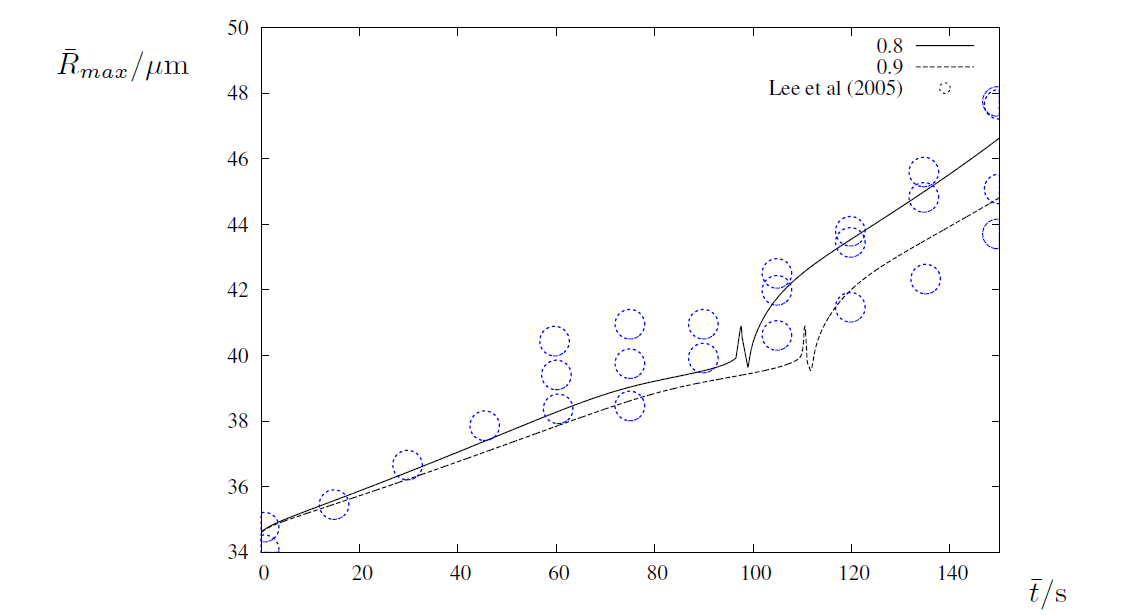
The growth of a bubble subject to an acoustic rectification over 6 million cycles of oscillation. Our theory using matched asymptotic expansions in space and multi-scales in time correlates with experiments (cycles). This is the first rational model that predicts the development of ultrasound cavitation development. This milestone development will have long, wide and important impact in research and applications of ultrasound cavitation.
saturated fusion systems defined on maximal class p-groups. In a slightly different direction, in joint work with Jason Semeraro, Chris has developed computational methods to work with fusion systems using computers.
Bubble oscillation
Bubble oscillation
Wang, Q. X., Liu, W.K., Corbett, C. and Smith, W. R. 2022 Microbubble dynamics in a viscous compressible liquid subject to ultrasound. Physics of Fluids 34, 012105
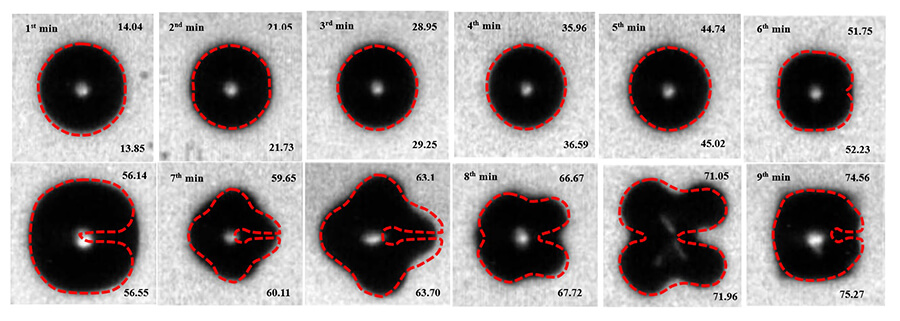
Bubble oscillates subject to an acoustic wave. This is the only available numerical model that agrees excellently with experiment images for non-spherical bubbles in a dozen cycles of oscillations.
Bubble dynamics near a rigid boundary
Bubble dynamics near a rigid boundary
You, Y. Cui, J.,Smith, W. R. and Wang, Q. X. Computational and experimental study for bubble dynamics near a rigid boundary for a Reynolds number of O(10-100)
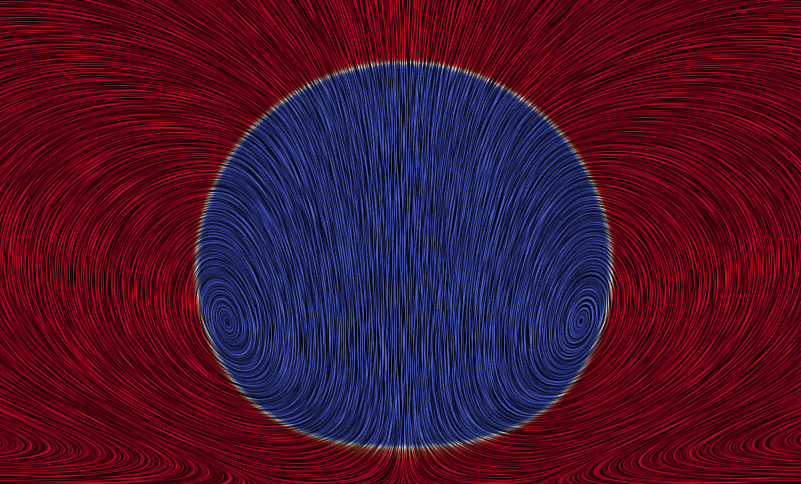
We show that a vortex ring associated with a toroidal bubble is not generated instantaneously as the liquid jet penetrates the bubble, as assumed for over a half of century, but develops within the bubble gas before that.
Grants and projects within the School of Mathematics
The School of Mathematics has received a number of research grants from funding bodies over the years. Learn more about the current grants and projects on offer through our Research Portal.
Seminars and events
Seminars in Continuum Mechanics usually take place every week during term time. For more information, or to be added to the mailing list, please contact maths-seminars@contacts.bham.ac.uk.