

Anxiety
After a mini stroke (TIA) or minor stroke, some people may experience anxiety and worry about having a stroke. There are many different ways of managing anxiety which can help you reduce its effects on your mental and physical wellbeing.
I referred myself for counselling because I can’t cope with the anxiety, I don’t want to feel anxious all my life…

How can I manage my anxiety?
There are self-management strategies, resources and organisations to help make things a little easier for you, some of them can be found below:
Self-management strategies are summarised in this infographic.
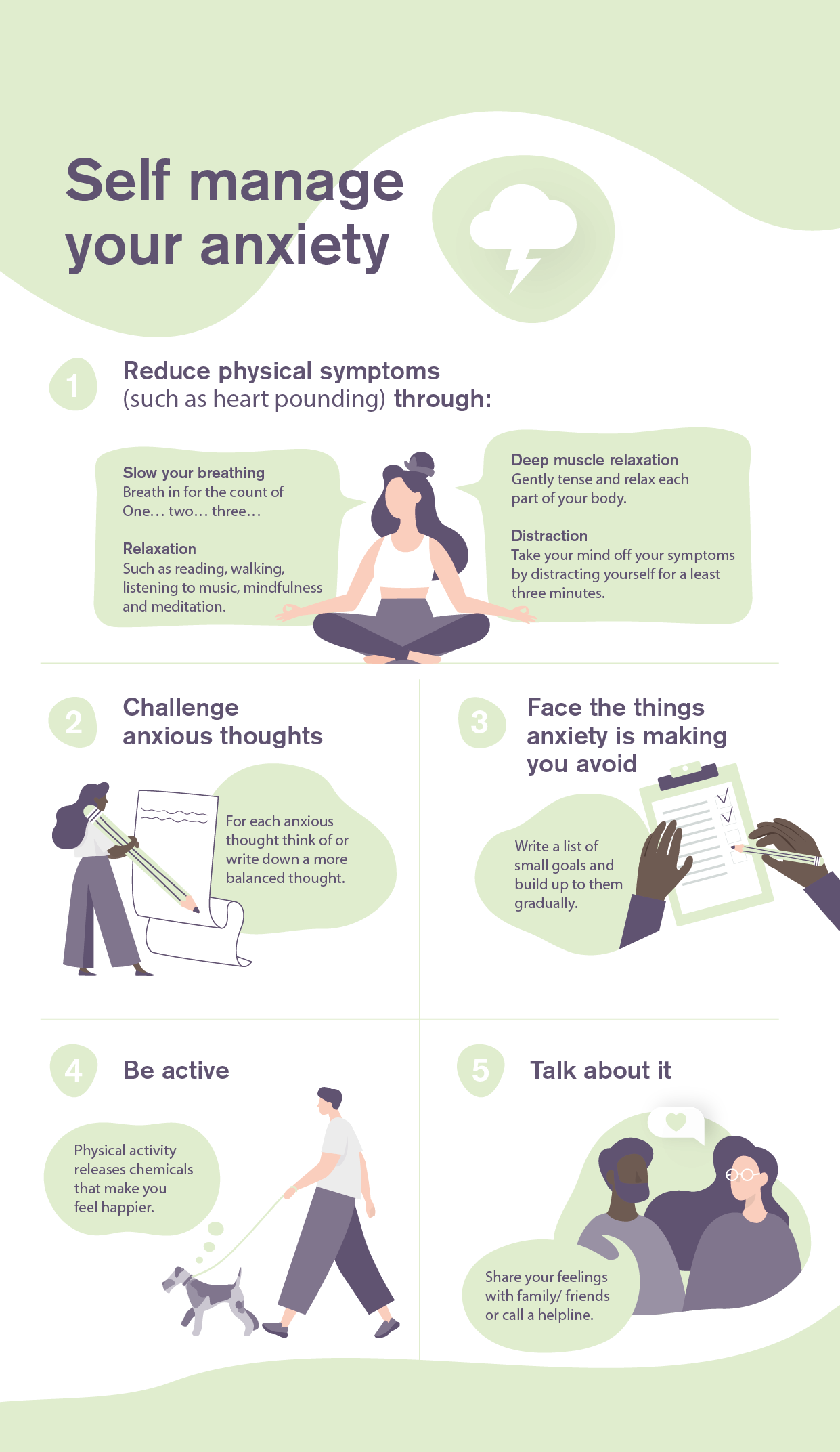
1. Reduce physical symptoms
1. Reduce physical symptoms
The techniques below can help reduce physical symptoms, such as heart pounding, feeling sick, difficulty breathing and sweating:
Slow your breathing
Breathe in and out for the count of three. Repeat.
There are videos, and websites with guided breathing exercises.
Relaxation
You may already know what relaxes you, such as reading, walking or listening to music.
Some relaxation techniques need to be practiced, such as mindfulness. There are videos, websites, podcasts and apps to help with mindfulness.
Deep muscle relaxation
Gently tense and relax each part of your body. Tense for 3 seconds and then relax.
There are audio tracks with guided muscle relaxation.
Distraction
Take your mind off your symptoms by distracting yourself for a least 3 minutes. For example:
- Sudoku/ crossword puzzles
- Count backwards from 1000
- Study something in detail, such as how many cars can you see.
2. Challenge anxious thoughts
2. Challenge anxious thoughts
Notice your anxious thoughts and challenge them.
For each anxious thought, think of or write down a more balanced thought. It can be helpful to keep a diary of these thoughts. For example:
Anxious thought: "I don’t want to go to the supermarket because that’s where I had my mini stroke and I’m worried I’ll have another one."
Balanced thought: "The supermarket is not linked at all to my mini stroke."
3. Face the things anxiety is making you avoid
3. Face the things anxiety is making you avoid
Recognise when you are avoiding things due to your anxiety and gradually tackle this avoidance. It can be helpful to write a list of small goals:
For example: build up to going to a busy shop by yourself
- Go for a walk by yourself
- Go to a local shop by yourself
- Meet a friend in a larger shop
- Go to a large shop by yourself for a short amount of time.
4. Be active
4. Be active
Physical activity releases chemicals into your brain that make you feel happier. Exercise also helps you focus on one activity and distracts from anxious thoughts.
Even short walks and gardening can help. You’re more likely be active if you plan it, do something you enjoy or do it with family or friends.
5. Talk about it
5. Talk about it
Talking to other people is really important.
Family and friends: sharing your feelings can help them understand what you are going through and how to support you.
Other people who have had mini stroke (TIA)/ minor stroke: connect through social media groups and forums.
- Facebook: Transient Ischemic Attack TIA (mini stroke) support group
- Facebook: Different Strokes
Other people with anxiety: there are online forums for people with anxiety:
Helplines for anxiety or stroke:
Anxiety
Stroke
- Stroke Association: 0303 3033 100
- Different Strokes: 0345 130 7172 or 01908 317 618
What treatments are there for anxiety?
Talk with your GP if you think you could benefit from more support.
Talking therapy
Talking therapy
Cognitive behavioural therapy (CBT) is a talking therapy which can help you manage anxiety by changing the way you think and behave. Read more about CBT.
There are different ways to access CBT:
NHS (note: wait times can be long):
- Your GP may be able to refer you to CBT in your area or give you a login for an online CBT programme.
- Self-refer: Search for NHS CBT here
Private sector (note: this can be expensive):
Find a therapist experienced in CBT
Online CBT:
-
Living Life to the Full (free): A self-help life skills training package based on a CBT approach, for those with mild to moderate depression and anxiety.
-
Silver Cloud (NHS referral required): The programme is interactive, during sessions you can watch video clips, complete exercises and learn CBT techniques. You will be given tasks to complete during the week and between modules.
- Beating the Blues (NHS referral required): The programme consists of eight, one-hour sessions completed weekly.
Medication
Medication
- You may want to talk to your GP about medication for anxiety.
-
Some antidepressants can help with anxiety.
-
Beta-blockers are sometimes used to treat the physical symptoms of anxiety, such as a rapid heartbeat. But they don't reduce any of the psychological symptoms.
-
Pregabalin is sometimes used when someone has a diagnosis of generalised anxiety disorder (GAD). This is an antiseizure drug which is normally used to treat epilepsy, but is also licensed to treat anxiety.
Helpful resources
Self-help guides
Self-help guides
Information Leaflets
Information Leaflets
Websites
Websites
Anxiety helplines
Anxiety helplines
Breathing exercises
Breathing exercises
Mindfulness
Mindfulness
Videos:
Apps:
Podcast:
Websites:

Muscle relaxation
Muscle relaxation
Challenge anxious thoughts
Challenge anxious thoughts
App:
Talk about it
Talk about it
Online forums for people with anxiety:
Anxiety helplines:
- No Panic: 0300 7729844
- Mind: 0300 123 3393
-
Stroke charities:
- Call: 0303 3033 100
- Email the Stroke Association: helpline@stroke.org.uk
- My Stroke Guide
- The Stroke Association on Facebook
- Follow the Stroke Association on Twitter: @TheStrokeAssoc
Different Strokes
- Call: 0345 130 7172 or 01908 317 618
- Email Different Strokes: info@differentstrokes.co.uk
- Different Strokes on Facebook
- Follow Different Strokes on Twitter: @diffstrokes