
Equality, diversity and inclusion (EDI) in the School of Mathematics
At the School of Mathematics, we are a diverse community of undergraduate students, postgraduate students, researchers, academics and professional services staff. 


Our commitment to EDI
Our commitment to EDI
Equality, diversity and inclusion (EDI) are key values that help our school create and maintain the atmosphere conducive to excellent education and world-leading research and to assure the wellbeing of staff and students.
We are committed to:
- preventing discrimination
- eliminating prejudice
- promoting inclusion
- celebrating diversity
We achieve this through:
- mindful treatment of colleagues and students
- inclusive curriculum design
- fair and transparent decision making
- ensuring our committees and decision-making groups have a diverse membership
EDI committee
The aim of our Equality and Diversity Committee is to provide an inclusive work environment that enables all individuals to succeed regardless of the status of their age, disability, gender reassignment, marriage and civil partnership, pregnancy and maternity, race, religion or belief, sex, and sexual orientation. The committee:
- advises on priorities for equality and diversity actions across the school
- reviews progress against specific sets of actions
- provides recommendations for improvement and revision of actions
- ensures that the proposed actions align with other institutional strategies and priorities
- communicates equality and diversity policies in the school and the university
- monitors the consistency in application of school and university-wide policies
- keeps the school informed and updated on university-wide policies
The committee comprises a mixture of staff and students in the School of Mathematics and is chaired by the School of Mathematics EDI Leads:
We hold at least one all-School EDI meeting each year to ensure everyone can get involved. There is an Athena SWAN action group in the School which shapes our future plans building on our Athena SWAN Silver award.
Staff networks
The University of Birmingham has a number of staff networks that are run independently by staff from across the University and provide a supportive environment for staff to discuss common issues and concerns. The networks also act in an advisory role to the University through the Equality Executive Group (our senior equality body) and are supported by the Equality & Diversity Team. More details about these networks can be found on the staff networks SharePoint page.
Our partnerships
- We are proud to hold an Athena SWAN Silver award. Athena SWAN is a national initiative that recognises the advancement of gender equality, representation, progression and success for all in academia
- We support the London Mathematical Society Good Practice Scheme, whose aim is to support mathematics departments to embed equal opportunities for women within their working practices
- We run a local branch of Piscopia which forms a UK-community of women and non-binary students and mathematics researchers. University of Birmingham Piscopia Committee web page
- The University of Birmingham holds the Advance HE's Race Equality Charter Silver award, a framework through which we are working to self-reflect, identify and remove barriers standing in the way of Black, Asian and Minority Ethnic staff and students
EDI activities
EDI activities
Throughout the year we run a range of activities to celebrate and support students and staff from groups that are typically underrepresented in Mathematics. We've summarised some examples of these activities below.
Local Piscopia branch
Our local Piscopia branch is a team of talented postgraduate mathematics researchers who are passionate about increasing diversity in the subject. They run a series of events to support and encourage female and nonbinary students to study for MSc programmes and PhDs. This has included producing this fantastic booklet on How to apply for a PhD (PDF, 1.1 MB). Furthermore, they hold a weekly coffee morning for any female and nonbinary members of the department (and allies!) to attend in our School.
Student events for minority ethnic and LGBTQ+ students
In addition to social events for all students, we run termly events for students from ethnic minority backgrounds and for students from the LGBTQ+ community to ensure that we can help them build support networks and get the most out of their student experience during their time with us.
Study space for students with disabilities
Dedicated weekly study space with postgraduate teaching support for students with disabilities and their friends. This is in addition to various modes of support available to all students (e.g. Guided Study Sessions, lecturers’ Office Hours, small group tutorials, peer assisted study sessions, drop-in support at the Maths Support Centre in the main library).
Undergraduate Summer Bursaries
We offer students the chance to participate in a paid research project during the summer break. We particularly encourage applications from students identifying with groups that are typically underrepresented in STEM and each year we’re able to fund a number of students across our home campus in Edgbaston and at our Jinan-Birmingham Joint Institute in China.
Social activities for postgraduate taught students
We have dedicated social activities for postgraduate taught students. Many of these students are new to Birmingham when they arrive, and these events ensure that they are quickly aware that they’re a valued part of our School of Mathematics community.
Mentoring schemes for early career researchers
We run mentoring schemes for early career researchers (including postdoctoral researchers) to help them navigate their career path, find out about training opportunities, and receive independent advice on applying for funding.
Mentoring schemes to support promotion
We run mentoring schemes to support and encourage staff to apply for promotion. This particularly supports those members of staff who might otherwise be hesitant at putting themselves forward for promotion.
Accessing support
Accessing support
We strive to create an environment where everyone can be themselves and reach their full potential.
Inclusivity Charter and challenging unacceptable behaviour
We have implemented an Inclusivity Charter (see below) that sets out how we expect people to behave and that also empowers us all to challenge unacceptable behaviour.
Should you witness or experience any unacceptable behaviour, we urge you to report it to the School EDI leads, Professor Simon Goodwin (s.m.goodwin@bham.ac.uk) or Dr Susana Gutierrez (s.gutierrez@bham.ac.uk). Alternatively, you can submit an anonymous report. If you provide your details, then we will discuss with you the different options available to deal with the incident, to ensure that it is dealt with in a manner that suits you.
Accessing support
There are dedicated university intranet pages for both students and staff to highlight wider Equality, Diversity & Inclusion initiatives at the University of Birmingham. Within the School we have developed a suite of resources to support members of the school including:
- guidance and support on returning from parental leave;
- advice and support for work related travel where one or more protected characteristic can be a barrier;
- MATHEMARENTS, our School of Maths Parents Network.
Creating an inclusive environment
Within the School of Mathematics, we have a block of gender neutral toilets with an accessible toilet, a shower, a baby changing mat and free sanitary products. We share a breast-feeding room and mental health space with the School of Physics and Astronomy, who are located in the adjoining building.
Celebrating diversity
Celebrating diversity
Current and former members of our School share their mathematical journeys to celebrate equality, diversity and inclusion.
Yin Hoon Chew (She/Her)
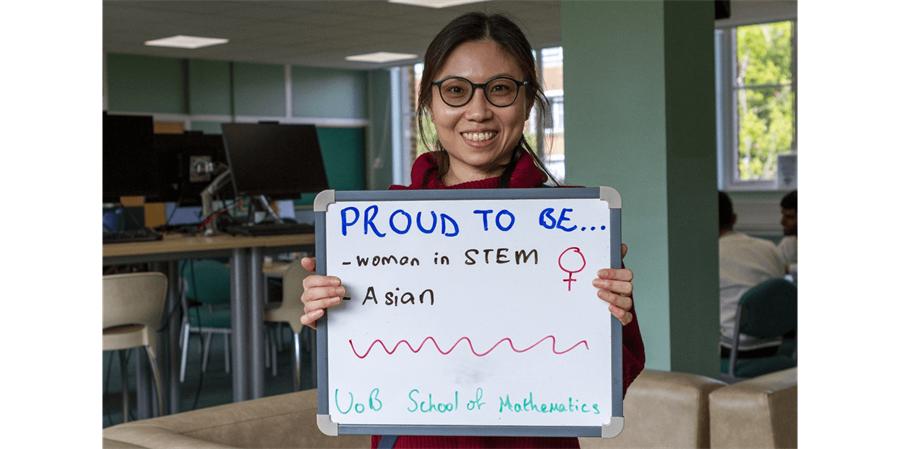
I cannot recall when my journey began. Probably since I was a child. After all, everything in our surroundings can be related to mathematics. I remember enjoying the subject in school. Compared to other subjects like languages, it was the only one where there were definite answers and I could even prove them! That gave me lots of joy and satisfaction.
As my academic journey continued, I went on to study Chemical and Bioprocess Engineering, a very applied 'branch' of mathematics. Now, I do research in the area of Mathematical and Computational Biology. As the name suggests, it is the combination of Mathematics, Computer Science and Biology.
To be honest, I did not enjoy Biology when I was in school. Perhaps it was the way the subject was presented to me, but I thought it was a boring subject that only involved memorising structures and functions. No laws, not many conceptual ideas, and no derivations! (Gasp!) I started enjoying Biology when I learned that we could use Mathematics to discover new biology. Isn't that fun? I look forward to whatever comes next on this journey.
Rowland Seymour (He/Him)
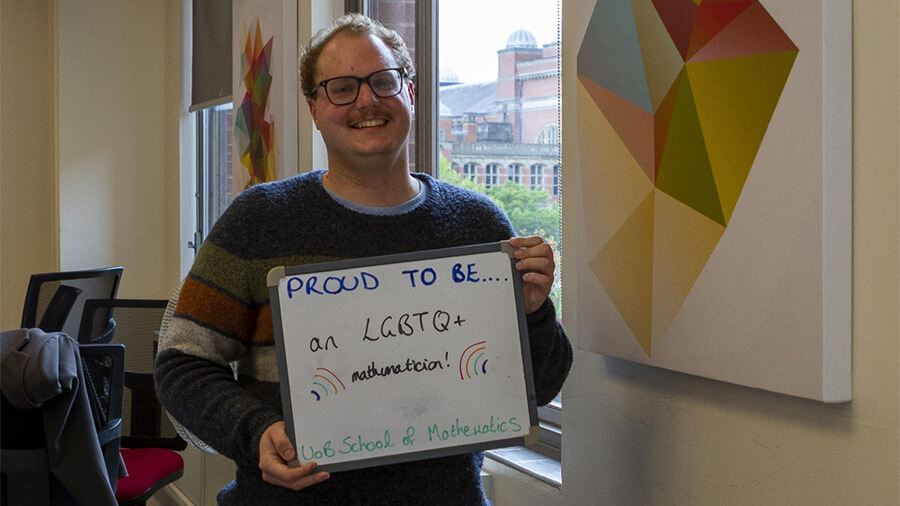
I'm Rowland and I'm a gay statistician. I did my undergrad in Southampton, before doing my PhD in Nottingham. My PhD was in epidemic modelling, looking at how diseases like bird flu spread. Recently, I've been using statistics to measure and identify human rights abuses, like human trafficking and forced marriages. I think statistics is a really powerful tool in identifying where abuses are happening and measuring how successful programmes are to stop abuses.
Being an LGBTQ+ ally is a great way to support the community. Not everyone is out, so a good way of being an ally is to avoid making assumptions about how someone identifies or who they might be dating. You might want to check with the person how they identify and if they would like to keep this confidential.
Rahma Abdulahi (She/Her)
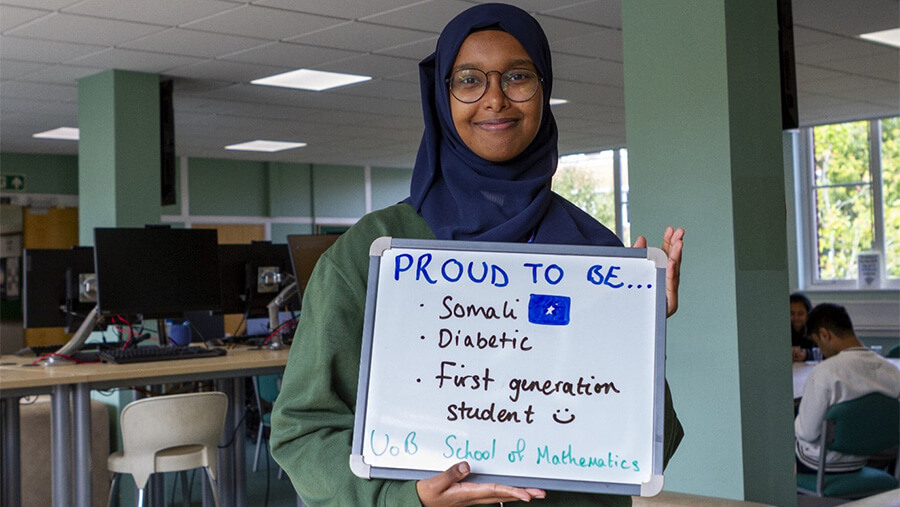
My name is Rahma Abdulahi, and I am a female PhD student, completing a project in Applied Mathematics. I graduated from the University of Birmingham with an MSci in Mathematics in 2021.
I come from a first generation immigrant Somali family that moved from the Netherlands to a low income area of Birmingham when I was 5, all the while fleeing a civil war in my home country. I am the first of my family to attend university, and it was during my time in university that I was diagnosed with type 1 diabetes.
Being at the intersection of various identities means that I have and will navigate my life differently to others but also that I can empathise with more people than most.
Guppy Meyer (She/Her)

As a youngster I would never have thought that the prospect of attaining a degree was on the cards for me, having grown up in Handsworth, Birmingham where no one in my family had gone to university. It wasn’t until I’d visited The University of Birmingham in Year 9 for a Science Fair did I really seriously consider the doors that a university education could open. Being the eldest of four and watching my parents work hard to make ends meet, I wanted to do them proud and be a role model for my siblings.
My love for Maths grew slowly through secondary school. When going on to study it at A Level did I really appreciate the joys of thinking logically. It was always interesting to see how there were numerous approaches to solving a Maths problem (given that there was an exact solution). My fondest memory whilst studying AL Maths was helping my peers and explaining how I tackled a problem.
Having attained all As in my A Levels in Maths, Accounting and ICT, I was delighted to have been accepted at The University of Birmingham to study BSc. Mathematics, after the campus had left such a great impression on me at a young age. My three years here were definitely some of my best. I was well supported by the department and felt I could take a good mix of modules to really expand my knowledge in different fields. I was studying and working part time at Tesco at the time and even though at times this felt like a lot to be juggling, I felt that it set me up for the real-world in terms of time management and organisation. The hard work was worthwhile when I graduated with a first.
I went onto to pursue a career as a Maths teacher for GCSE and A Level, in the hope that I could motivate young people to enjoy Maths or other STEM subjects the same way I did and boost my confidence, as I was always a quiet and shy individual. I really enjoyed my time as a teacher; delivering topics in a way in which students could relate to as well as promoting university as an option to those that had come from a similar background as mine.
Eight years later, I landed back at The University of Birmingham working for the Careers Network and now the Student Recruitment team within Engineering and Physical Sciences; being able to interact with prospective and current students and share my experiences as an alumna. It definitely feels like home and goes to show that a STEM degree can take you on quite a journey and open up many opportunities.
Our Inclusivity Charter
Our Inclusivity Charter
The School of Mathematics is committed to providing a welcoming, inclusive and safe community for all. We expect cooperation and support from all staff, students and visitors to help ensure an environment where everyone is treated fairly and where diversity is valued.
All members of the School community have a responsibility to uphold our commitment to equality by:
- treating students, staff and visitors to the University with dignity and respect
- not engaging in, colluding in or encouraging behaviour that constitutes unlawful discrimination under the Equality Act
- supporting activities to eliminate discrimination, advance equality of opportunity and foster good relations as required under the Equality Act.
Everyone in the School has the right to be treated with dignity and respect. We believe all forms of harassment, bullying and discrimination are unacceptable. This includes but is not limited to:
- insults, name-calling and offensive language and gestures
- inappropriate jokes
- ridiculing and undermining behaviour
- inappropriate or unnecessary physical contact
- physical assault or threats of physical assault
- intimidating, coercive or threatening actions and behaviour
- unwelcome sexual advances
Should anyone experience or witness behaviour contravening the School of Mathematics’ Inclusivity Charter, please intervene where you feel comfortable doing so. We strongly urge you to report this behaviour: