
Biofilms
The image below shows the geometry of the biofilm, with an inert substratum at the bottom, and the bulk liquid at the top, separated from the growing biofilm by a mass transfer boundary layer at a constant height above the biofilm. The substrates diffuse downwards from the bulk liquid through the boundary layer into the biofilm. The x (width) and y (depth) dimensions are periodic.

The effect of chance on the growth of individual cells in a highly heterogenous environment is shown by this image of the clonal sectors of a biofilm, where each of the 10 ammonia oxidisers in the inoculum and their offspring is rendered in a different colour. All the nitrate oxidisers, which don't grow very much are shown in the colour magenta.
Cells that happened to be close to others at the start of the simulation gave rise to clones that become suffocated eventually (see the red, yellow, dark blue, orange, and silver cells). In contrast, cells that were far apart from their nearest neighbours at the beginning gave rise to the largest clones. This image is also a good visualisation of what periodic boundaries are, look at how the large blue clone appears to be split into two strips, one on each side, although it is actually only one strip because the borders are wrapped around.
The mechanism of biomass spreading was found to have a marked influence on biofilm structure. The mutual shoving mechanism used in BacSim is illustrated by a movie displaying the positions of cells from time-step to time-step, starting with randomly placed cells. In this case, a very flat computational domain (0.1 µm depth) was used in order to make overlaps easier to see.
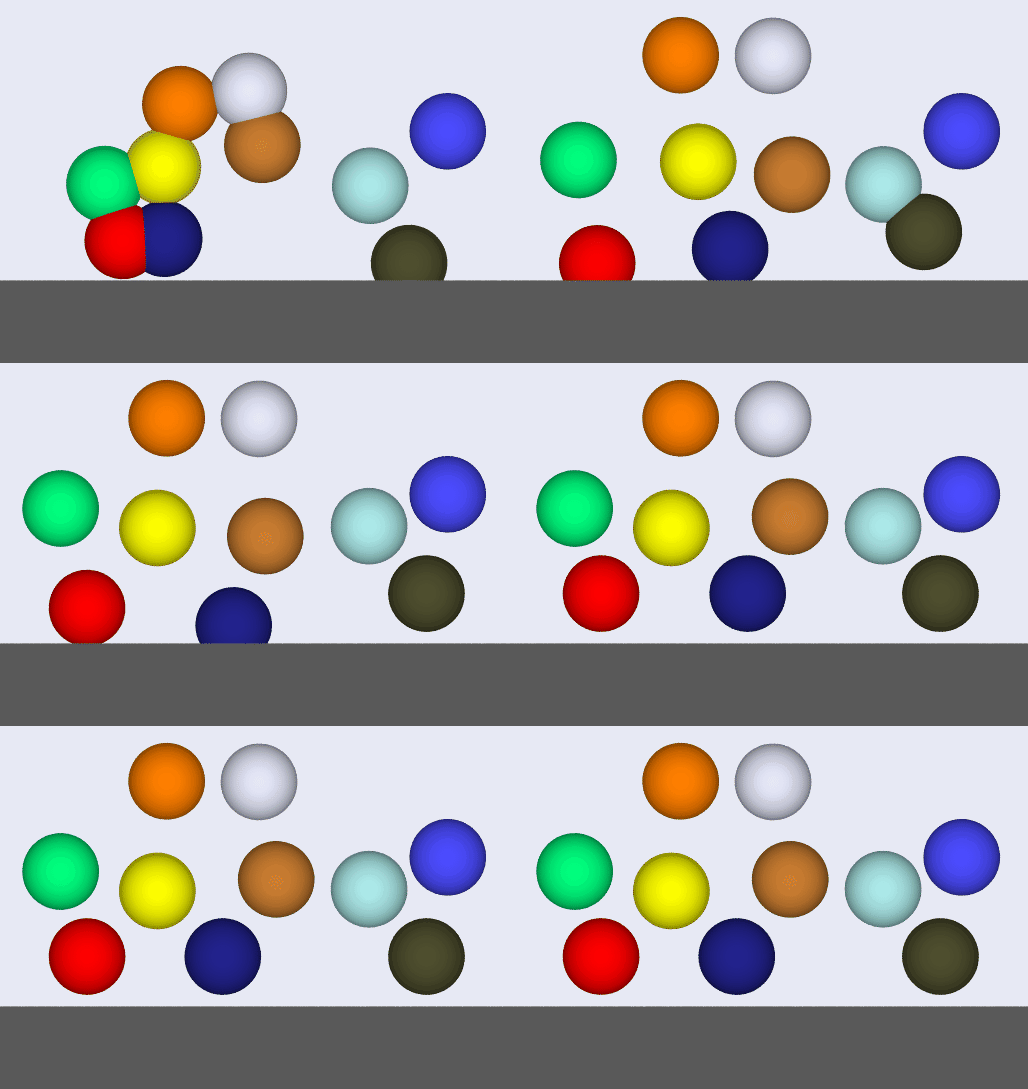
Short-term fluctuations of biofilm structure resulting from the shoving of cells from one time-step to the next, after about 30,000 min (3 weeks) of growth, are shown in this movie.

The main conclusions from this project are about the effect of the three processes diffusion-reaction, biomass spreading, and chance on the growth and shape of biofilms. Diffusion-reaction directly influences biofilm growth, while biomass spreading mechanisms directly influence biofilm shape, making shape partially independent of diffusion-reaction driven growth. Growth and shape both influence each other. Chance has a profound influence on biofilm shape and the growth of single cells or rare species, because of the high heterogeneity of substrate concentrations in the biofilm, which results from both diffusion-reaction and spreading.
Detailed documentation of this model is part of the 2001 paper in Microbiology. You can also download the source of the model, or run the simulation in your web browser, see the section on BacSim.
Compare biofilms simulated with Cristian Picioreanu's Biomass-based model with Individual-based model biofilms. The images show biofilms after 96,000 min (67 days, 9.5 weeks) of growth and the short movies visualise the first three weeks of growth, while the long movies cover the whole period. Unfortunately, the long movies are exceedingly large and only for the determined.

Biofilm, aged 96,000 min (67 days, 9.5 weeks). The contour lines show the oxygen concentration in mg/l. The image was rendered with POV-Ray, showing each biomass brick as a sphere. The biomass of the ammonia oxidisers ("Nitroso") is green; the biomass of the nitrite oxidisers ("Nitro") is red. The grey box at the bottom is the inert substratum. Note the wrapped around boundaries in the horizontal direction.This Biomass-based model version (apart) does not allow the coexistence of biomasses of the two species in the same grid element. The nitrite oxidisers grew only poorly because the ammonia oxidisers have a kinetic advantage under oxygen limitation. Oxygen limitation is clearly visible from the contour lines, and results from the high concentration of ammonia and nitrite in the bulk liquid.

Biofilm, aged 96,000 min (67 days, 9.5 weeks). The contour lines show the oxygen concentration in mg/l. The image was rendered with POV-Ray, showing each biomass brick as a sphere. The biomass of the ammonia oxidisers ("Nitroso") is green; the biomass of the nitrite oxidisers ("Nitro") is red. These colours were chosen in order to make the overlapping of biomasses of the two species easily visible. The grey box at the bottom is the inert substratum. Note the wrapped around boundaries in the horizontal direction. This Biomass-based model version (coupled) allows the coexistence of biomasses of the two species in the same grid element. Spreading of the two species is coupled if they exist in the same grid element.

Biofilm, aged 96,000 min (67 days, 9.5 weeks). The contour lines show the oxygen concentration in mg/l. The image was rendered with POV-Ray, showing each biomass brick as a sphere. The biomass of the ammonia oxidisers ("Nitroso") is green; the biomass of the nitrite oxidisers ("Nitro") is red. These colours were chosen in order to make the overlapping of biomasses of the two species easily visible. The grey box at the bottom is the inert substratum. Note the wrapped around boundaries in the horizontal direction. This Biomass-based model version (mixed) allows the coexistence of biomasses of the two species in the same grid element. Spreading of the two species is independent rather than coupled. This gives the random spreading process a greater chance to mix biomasses of the two species, effectively enhancing the spreading of the minority species. More cells of the minority species end up higher in the biofilm where they grow better.

Biofilm, aged 96,000 min (67 days, 9.5 weeks). The contour lines show the oxygen concentration in mg/l. The image was rendered with POV-Ray, showing each cell as a sphere. The ammonia oxidisers ("Nitroso") are green; the nitrite oxidisers ("Nitro") are red. The grey box at the bottom is the inert substratum. Note the wrapped around boundaries in the horizontal direction. In the Individual-based model, cells are spread independently of each other. Cells are spheres rather than bricks and exist in continuous space rather than on a discrete grid. However, this leads to less mixing since the spreading mechanism is not random but deterministic.