- Reader in Chemical Imaging, Deputy Head of School
- School of Chemistry
Areas of interest: Analytical chemistry; batteries; electrochemistry; magnetic resonance spectroscopy and imaging; simulation and modelling; soft matter
Representative publication: Operando visualisation of battery chemistry in a sodium-ion battery by 23Na magnetic resonance imaging
Joshua M. Bray, Claire L. Doswell, Galina E. Pavlovskaya, Lin Chen, Brij Kishore, Heather Au, Hande Alptekin, Emma Kendrick, Maria-Magdalena Titirici, Thomas Meersmann & Melanie M. Britton
Nature Communications 11 (2020) 2083
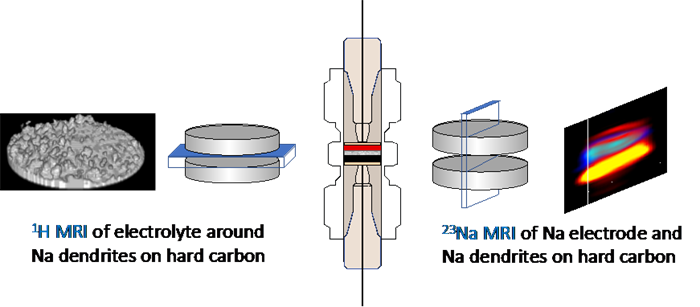
Sodium ion batteries (NIBs) offer significant cost and sustainability benefits over current lithium ion batteries, while maintaining high energy densities. Yet, there remain many challenges preventing their commercialisation, which is driving the development of improved SIB electrodes and electrolytes, as well as better understanding of the solid-electrolyte interphase and dendrite formation. Yet, the search for, and optimisation of, new sodium ion battery materials requires detailed measurement and characterisation, in operando, of each battery component, as well as the interactions and synergies between components and the causes of battery degradation. These detailed observations are currently lacking and inhibiting progress. This paper addresses this deficiency and reports the development of in operando 23Na magnetic resonance imaging (MRI) to enable, for the first time, direct visualisation of battery chemistry in a NIB, an exploration of the synergies between multiple components within the NIB and an assessment of the behaviour of a novel non-graphitic carbon SIB electrode material. This paper reveals new information about the environment and distribution of sodium within the NIB, which is correlated with the electrochemical behaviour of the cell. We observe, for the first time, the formation of sodium dendrites during galvanostatic plating in a sodium-metal cell and, more surprisingly, metallic sodium species on hard carbon upon first charge (formation) in a full-cell configuration.