The Salon presents: Student Mental Health
- Dates
- Thursday 18 November 2021 (13:00-14:00)
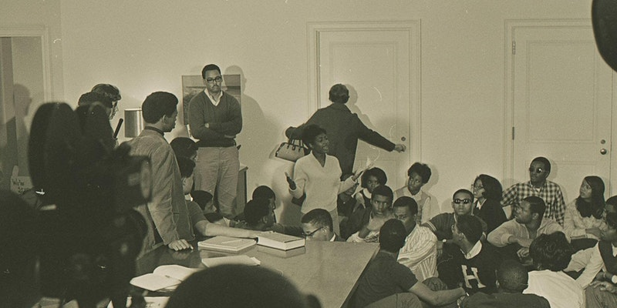 Allen Building Study-In 13 November 1967, Duke University Archives, Durham, North Carolina, USA. library.duke.edu/uarchives CC BY-NC-SA 2.0
The Salon is centred on the theme of student mental health. We are delighted to welcome three provocateurs to get discussions started:
1) Sarah Crook is lecturer in post-1800 European Social and Cultural History at Swansea University. She held a Junior Fellowship at New College, Oxford after being awarded her PhD in 2016. Her current research explores the history of concern about student mental health in Britain.
2) Rachel Winter is a Research Fellow at the University of Birmingham. She has a background in in medical sociology and qualitative methods. She specialises in using online and offline ethnography to research mental and physical health. In her current work she explores online discussions about self-harm and suicide content, and how people engage with such content. Her research also focuses on the ways in which young people use social media to discuss their mental health and provide peer-support to each other.
3) ‘Proud to be…’, a poem by Romwell (26), a member of the Youth Advisory Group to the Institute for Mental Health (University of Birmingham). This poem was initially written to support an online event that was part of the University of Birmingham’s Black History Month event series. ‘Proud to be shaping health and social care research’ provided a platform for a panel of members from the West Midland’s Black community to discuss their involvement in research as public contributors and their views on the under-representation of the Black community in health and social care research.
It’s well acknowledged that there are several health inequalities faced by racially minoritised communities in the UK. These inequalities can be a result of several factors including socioeconomic factors, cultural differences and inadequacy of services accessibility/suitability. In sharing this poem, I hope to provoke thought about how the diversity of student populations are accounted when mental health support is offered. There are many societal and service-related factors that may lead some students to feel unseen or like they will be remain invisible as they don’t match a certain criteria and so need to jump through awkward and challenging processes before they are seen. What can be done to mitigate these barriers?
This new monthly virtual discussion is part of the Mental Health and Medical Humanities Initiative, instigated by the Institute for Mental Health, but owned by scholars across campus at the University of Birmingham. Online each month, an internal and external speaker act as ‘provocateurs’, offering brief 5-minute presentations that might be rooted in a reading, a piece of art, or a key theme from their research. The Salon aims to recreate stimulating, interdisciplinary discussions, which maximise ideas and collaborations and slot discretely into busy schedules.
Image: Allen Building Study-In 13 November 1967, Duke University Archives, Durham, North Carolina, USA. library.duke.edu/uarchives CC BY-NC-SA 2.0