

Depression and low mood
Your mini stroke (TIA) or minor stroke may affect you emotionally as well as physically. Emotional impacts can be missed by healthcare providers and family/ friends because they are “hidden”. Your GP will be able to talk to you about how you are feeling and discuss the various therapies and services which might best support you.
I get very depressed… I feel mentally tired, not physically, physically I feel okay.

How can I manage low mood?
There are self-management strategies, resources and organisations to help make things a little easier for you, some of them can be found below:
Self-management strategies are summarise in this infographic.
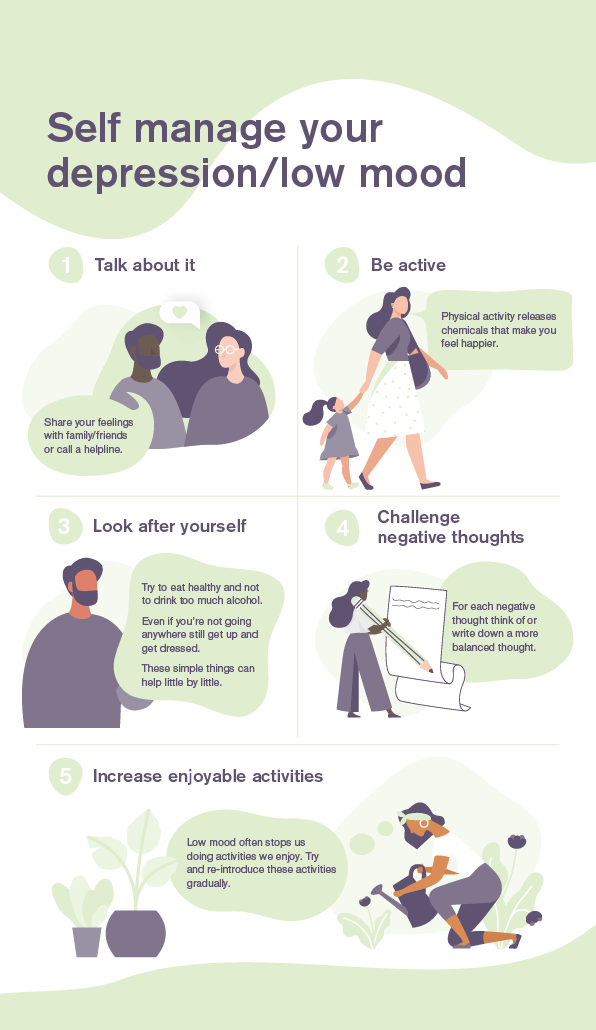
1. Talk about it
1. Talk about it
Talking to other people is really important.
Family and friends: sharing your feelings can help them understand what you are going through and how to support you.
Other people who have had mini stroke (TIA) or minor stroke: connect through social media groups and forums:
Other people with depression: there are online forums for people with depression:
Helplines for depression or stroke:
Depression
- Mind: 0300 123 3393
- Samaritans: 116 123
Stroke
- Stroke Association: 0303 3033 100
- Different Strokes: 0345 130 7172 or 01908 317 618
2. Be active
2. Be active
You may not feel up to it, but try to keep active. Physical activity releases chemicals into your brain that make you feel happier.
Even short walks and gardening can help. You’re more likely be active if you plan it, do something you enjoy or do it with family or friends.
3. Look after yourself
3. Look after yourself
- Try to eat healthy and not to drink too much alcohol.
- Even if you’re not going anywhere still get up and get dressed.
These simple things can help little by little.
4. Challenge negative thoughts
4. Challenge negative thoughts
There are different strategies to stop negative thoughts affecting your mood.
Balance negative thoughts with positive ones:
For each negative thought think of or write down a more balanced thought. It can be helpful to keep a diary of these thoughts. For example:
Negative thought: "I'm a burden on my family."
Balanced thought: "I know my family love me and want to help and support me."
There are apps and worksheets to help you
Remember details:
Often people with depression think in general statements, such as “I’m no use to my family”. Train yourself to remember specific details so positive experiences are easier to recall; for example, write down all the ways you support your family.
Mindfulness:
Research shows mindfulness can improve mental wellbeing. There are videos, websites, podcasts, and apps to help you.
5. Increase enjoyable activities
5. Increase enjoyable activities
- When we have low mood, we often stop doing important or enjoyable activities.
- Try listing these activities and re-introduce them gradually. Start with the easiest ones.
What treatments are there for depression?
Talking therapy
Talking therapy
Cognitive behavioural therapy (CBT) is a talking therapy which can be offered individually or as part of a group. Read more about CBT.
There are different ways to access CBT:
NHS:
-
GP: Your GP may be able to refer you to CBT in your area or give you a login for an online CBT programme.
-
Self-refer: Search for NHS CBT
Private sector:
Online CBT:
- Living Life to the Full (free):A self-help life skills training package based on a CBT approach, for those with mild to moderate depression and anxiety.
- MoodGYM (£23 for 12 months): A CBT based program by the Australian National University. It helps you identify and overcome problem emotions and develop good coping skills.
- Silver Cloud (NHS referral required): The programme is interactive, during sessions you can watch video clips, complete exercises and learn CBT techniques. You will be given tasks to complete during the week and between modules.
- Beating the Blues (NHS referral required):The programme consists of eight, one-hour sessions completed weekly.
Medication
Medication
Antidepressant drugs affect chemicals in your brain and lift your mood. Antidepressants don’t cure emotional problems, but they can help with the symptoms. There are many different types of antidepressants. Speak to your GP if this is something you would like to try.
Helpful resources
Self-help guides
Self-help guides
Information leaflets
Information leaflets
Websites
Websites
Helplines for depression
Helplines for depression
- Mind: 0300 123 3393 Open 09:00 to 18:00, Monday to Friday (except for bank holidays)
- Samaritans: 116 123 Open 24 hours a day, 365 days a year or email jo@samaritans.org
Mindfulness
Mindfulness
Videos:
Apps:
Podcast:
Websites:
Challenge negative thoughts
Challenge negative thoughts
App:
Worksheet:
Talk about it
Talk about it
Online forums for people with depression:
Helplines for depression:
- Mind: 0300 123 3393 Open 09:00 to 18:00, Monday to Friday (except for bank holidays).
- Samaritans: 116 123 Open 24 hours a day, 365 days a year or email jo@samaritans.org
Stroke charities
Stroke charities
Stroke Association:
- Call: 0303 3033 100
- Email: helpline@stroke.org.uk
- My Stroke Guide
- The Stroke Association Facebook
- Twitter: @thestrokeassoc
Different strokes:
- Call: 0345 130 7172 or 01908 317 618
- Email: info@differentstrokes.co.uk
- Different Strokes Facebook
- Twitter: @diffstrokes