

About Physics and Astronomy
We are one of the largest physics departments in the country with a high profile for research both in the UK and internationally, covering a wide range of topics offering exciting challenges at the leading edge of physics and astronomy.
In the Research Excellence Framework 2021, our physics research is ranked 4th in the UK for GPA and top for 4* research.
In terms of teaching, we have consistently performed very well in the rankings. For more detail see our homepage and associated links.
Staff are active in a wide range of research fields including Astronomy, Condensed Matter Physics, Molecular Physics, Nanoscale Physics, Nuclear and Particle Physics, as well as Theoretical Physics and Medical and Radiation Physics. Courses in all of these topics (and many more) are available in our degree programmes, which are taught by internationally recognised experts.
History of the School
History of the School
The School of Physics and Astronomy traces its origin to the original Department of Physics which was opened on 1st October 1880 when Professor John Henry Poynting took office in new laboratories of Mason Science College at Edmund Street in Birmingham. Poynting had moved from Cambridge where he had been working with James Clerk Maxwell on electromagnetism and remained the Head of Department until his death in 1914.
There are numerous ways of following the history of the School since 1880. One could follow the University's Blue Plaque trail. The School has four plaques commemorating some key scientific discoveries:
- "Weighing" the Earth (plaque 12): John Henry Poynting measured Newton's gravitational constant (G) in 1890 and in so-doing was able to determine the mass of the earth. His legacy in Birmingham continues in many ways from work on deviations from the inverse square law of gravity which could signal the universe has high dimensions that simple space-time, through to the gravitational wave detection experiments and to the Poynting Physical Society which is our ever-popular student-led social society.
- The Frisch-Peierls Memorandum (plaque 9): Otto Frisch and Rudolf Peierls were in 1940 the first to show that an airborne atomic bomb was feasible and this work was critical to the establishment of the Manhattan project. Peierls established in Birmingham one of the world-leading Schools of Theoretical Physics and our research activities particularly in the theory of quantum matter continue to the present.
- The Cavity Magnetron (plaque 10): John Randall and Harry Boot devised a device in 1940 that made possible airborne radar. This device is now used to provide the power in every domestic microwave oven. Manipulating electromagnetic waves is the domain of a new research group in the School studying transformational optics and metamaterials.
- The proton synchrotron (plaque 11): Mark Oliphant pioneered the early days of particle physics by building a proton synchrotron in 1953. These are now integral to high energy particle physics today - including the Large Hadron Collider where the School is currently playing a leading role.
Another way to trace the history of the School is through our collection of scientific instruments. Many of the significant parts of the collection are on public display in the School and are catalogued as part of the University Collections. Dr Robert Whitworth maintains the collection.
Equality, Diversity and Inclusion
Equality, Diversity and Inclusion
Equality and diversity is a core principle both within the School of Physics and Astronomy, and the University of Birmingham at large.
Learn more about our Equality, Diversity and Inclusion.
Awards
Birmingham's Physics Nobel Prize winners
Birmingham's Physics Nobel Prize winners
Professor Mike Kosterlitz and Professor David Thouless were jointly awarded the Nobel Prize in Physics 2016 for their work into the discoveries of the properties of matter.
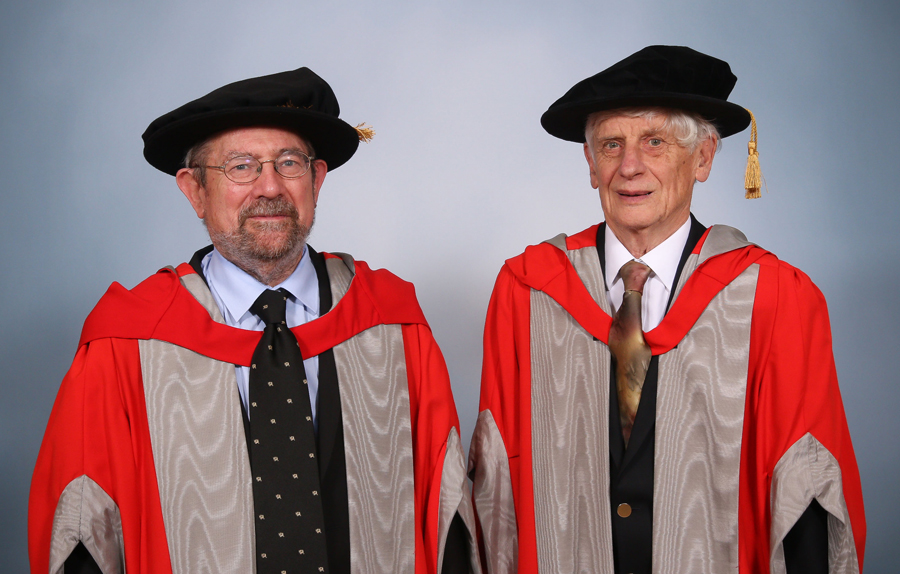
Professor Kosterlitz (left) was a Research Fellow in high energy physics before becoming Lecturer and then Reader at the University of Birmingham from 1970 to 1982. He is now Professor of Physics at Brown University, Rhode Island, US. During his time at Birmingham, he collaborated with Professor David Thouless on phase transitions driven by topological defects – work which later led to their Nobel Prize.
Professor Thouless (right) carried out post-doctoral work at Birmingham before becoming Professor of Mathematical Physics in 1965. While at the University, his collaboration with Professor Mike Kosterlitz on the theory of phase transitions in two dimensions was recognised in the Nobel Prize. His contributions to condensed matter theory have been recognised by many awards.
Kosterlitz and Thouless' research
Kosterlitz and Thouless' research
Professor Mike Gunn explains Kosterlitz and Thouless' research.
Professor Kosterlitz delivers guest lecture
Professor Kosterlitz delivers guest lecture
Professor Kosterlitz delivers his guest lecture at the School of Physics.
Enquiries
Contact us
Contact us
School of Physics and Astronomy
University of Birmingham
Birmingham
B15 2TT
United Kingdom
Email: physics@contacts.bham.ac.uk
Tel: +44 (0)121 414 4564
Key Contacts
Academic staff
Head of School
Deputy Head of School (Education)
Deputy Head of School (Research)
Director of Research
Director of School Culture
Director of Innovation
Head of Equality, Diversity and Inclusion
-
Chair of ED&I Committee: Dr Vincent Boyer
-
Athena Swan and IoP Juno Lead: Professor Cristina Lazzeroni
Head of Education
Deputy Head of Education and Head of Quality
Director of Learning and Teaching for Labs
Senior Tutor
Deputy Senior Tutor
- Dr Emma Willett
Heads of Year for Teaching
-
Year 1 - Dr Sean McGee
-
Year 2 - Dr Jon Watkins
-
Year 3 - Dr Mingee Chung
-
Year 4 - Dr Alan Watson
Undergraduate Admissions Tutor
Programme Director MSc Physics & Technology of Nuclear Reactors
Director of Graduate Research
Deputy Director of Graduate Studies
Careers Tutor
Professional Services staff
Wellbeing Officers
-
Contact the Wellbeing Team at physicswelfare@contacts.bham.ac.uk
Education Support
-
Undergraduate and Postgraduate Taught
-
Imogen Platt - Education Support Manager
-
Rachael Deen - Education Support Team Manager
-
Juliet Creese - Senior Education Support Administrator
-
Andrew Wordsworth - Senior Education Support Administrator
-
Sunya Hafiz - Senior Education Support Administrator
-
Kiran Chauhan - Education Support Administrator
-
Gail Rymkiewicz - Education Support Administrator
-
Charlotte Payne - Education Support Administrator
-
Tel: (+44) (0)121 414 6594
-
-
Postgraduate Research
-
Daniel Byrne - Education Support Administrator (PGR)
-
Tel: (+44) (0)121 414 6594
-
Operations
-
Kate Campbell - Head of Operations
-
Jo Cox - Operations Officer
Tel: (+44) 121 414 4564
Email: physics-ops@contacts.bham.ac.uk
Alumni Relations
-
Alumni Relations Manager
How to find us
How to find us
Location on Campus
The Clock Tower in Chancellor's Court in the centre of the map is the dominant feature of the campus skyline. The School of Physics and Astronomy buildings are all to be found east of the Clock Tower. The labelled buildings are Physics Poynting (R13), Physics West (R8) and Physics East (R10).
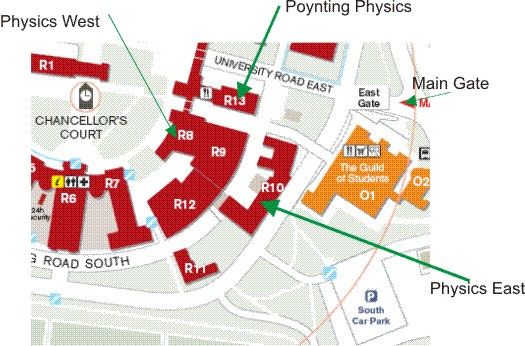
Map of the local area, taken from the Edgbaston Campus map
The main access by car is at the East Gate, this is normally manned, and is reached via Edgbaston Park Road which leads off the main Bristol Road (A38). From the East Gate entrance, proceed straight ahead and then take the second left turn.
If you are visiting for an Open Day or Applicant Day, please park on the North or Pritchatts Road Car Park or the North East Car Park (multi-storey). All car parks are Pay and Display. If you are using a satellite navigation device;
North Car Park - B15 2SB
North East Car Park - B15 2SA
Pritchatts Road Car Park (at the junction with Vincent Drive) - B15 2QU